Introduction
Krishnamurti Paddhati (KP) astrology has revolutionized Vedic astrological prediction by shifting focus from static planetary dignity to dynamic stellar governance. At the heart of this system lies a concept that separates successful KP practitioners from struggling ones: the correct understanding of significators and their 4-level hierarchy.
If you’ve been using Jagannatha Hora (JHora) software for KP analysis and still find your predictions inconsistent, you’re not alone. The problem isn’t with the software or even your birth time data—it’s almost always rooted in how you’re interpreting significators.
Here’s a reality check: approximately 80% of prediction errors in KP astrology stem from misunderstanding which significators actually matter. Many practitioners treat all significators as equal, when in fact there’s a strict hierarchy that determines which planets will actually deliver results and which ones are merely “supporting actors.”
This guide will transform how you approach KP predictions. You’ll learn exactly how to identify, rank, and apply significators using JHora 8.x, complete with real prediction examples you can verify against your own charts.
What Are Significators in KP Astrology?
Before diving into the hierarchy, let’s establish what a “significator” actually means in KP terminology.
A significator is a planet that has been granted authority to execute the matters of a specific house. Think of it as a planet being assigned responsibility for delivering results connected to that bhava (house). However—and this is crucial—not all assignments carry equal weight.
In traditional Vedic astrology, if Mars owns the 7th house and sits in the 10th, you’d primarily look at Mars for both 7th and 10th house matters based on ownership and placement. KP astrology works differently. The results a planet delivers depend primarily on its Star Lord (Nakshatra Lord), not just its position or ownership.
This is the foundational principle of KP: A planet gives the results of its Star Lord, modified by its Sub Lord.
Two Ways to Analyze Significators
There are two distinct approaches to significator analysis, and confusing them leads to prediction failures:
Planet-wise Signification asks: “Which houses does Planet X activate?”
This approach is essential when analyzing Dasha and Bhukti periods. When Jupiter Mahadasha begins, you examine which houses Jupiter signifies to understand what themes will dominate that period.
House-wise Signification asks: “Which planets can deliver results for House Y?”
This approach is essential for specific event predictions. If someone asks “When will I get married?”, you identify which planets signify houses 2, 7, and 11—the marriage combination—and then time the event using those planets’ periods.
The 4-level hierarchy we’ll discuss primarily addresses house-wise signification, which is what most predictions require.
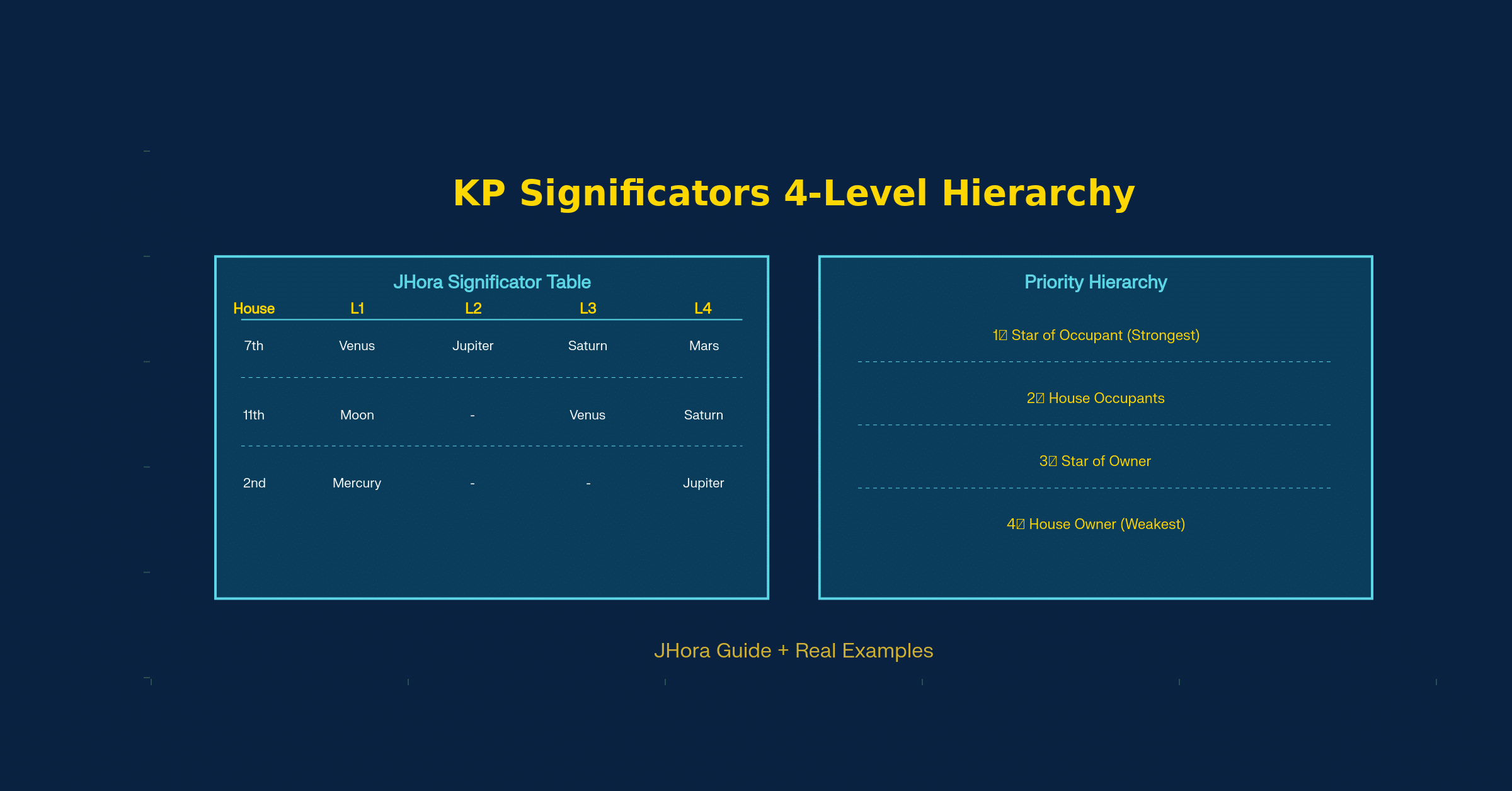
The 4-Level Significator Hierarchy Explained
K.S. Krishnamurti established a rigid hierarchy of four levels that determines significator strength. This isn’t arbitrary—it’s based on the stellar principle that governs all KP analysis.
Level 1 (Strongest): Planets in the Star of the House Occupant
Definition: Planets positioned in the Nakshatra of a planet that physically occupies the house.
This is the most powerful level of signification, and understanding why requires grasping the stellar principle deeply.
When Planet Y sits inside House H, Planet Y becomes like a tenant living in that property. The tenant has immediate access and influence over that environment. However, in KP theory, a planet yields its results to planets positioned in its stars. So when Planet X sits in the Nakshatra of Planet Y (the tenant), Planet X essentially “hijacks” the tenant’s power.
Planet X operates at the stellar level (the causal level), which is more powerful than Planet Y operating at the physical level. Planet X becomes the proxy executor of the house’s affairs.
Example:
Consider the 7th house (Marriage) with Jupiter sitting inside it. Venus is positioned in Punarvasu Nakshatra (ruled by Jupiter).
Result: Venus becomes the Level 1 significator for the 7th house. When timing marriage, Venus Dasha or Bhukti will be far more potent than Jupiter’s own period, even though Jupiter physically occupies the marriage house.
Level 2: Planets Occupying the House
Definition: Planets physically sitting inside the house.
If no planets occupy the stars of the house occupant (meaning the occupant is “untenanted” in stellar terms), the occupant itself becomes the primary result-giver. Even when Level 1 significators exist, occupants remain strong Level 2 significators.
Using our previous example, Jupiter in the 7th house wants to deliver marriage results. But because Venus sits in Jupiter’s star, Venus takes primary responsibility. Jupiter gets relegated to Level 2—still important, but secondary to Venus.
However, if no planet occupied Jupiter’s stars, Jupiter would retain full agency and effectively operate with Level 1 strength.
Level 3: Planets in the Star of the House Owner
Definition: Planets positioned in the Nakshatra of the planet that owns/rules the house sign.
When a house has no occupants, ownership becomes the primary link. The house lord owns the property but doesn’t live there—like a landlord living elsewhere. This connection exists but is less active than occupation.
Just as with occupation, the lord yields power to planets in its stars. So planets in the house lord’s Nakshatra become Level 3 significators.
Example:
The 7th house is empty. Mars rules the 7th (let’s say Aries or Scorpio is on the cusp). Saturn sits in Chitra Nakshatra (ruled by Mars).
Result: Saturn becomes a Level 3 significator for the 7th house.
Level 4 (Weakest Direct Significator): The House Owner
Definition: The planet that owns the sign on the house cusp.
This is the weakest of the direct significators. The house lord signifies the house through ownership, but delivers results strongly only when:
- The house has no occupants (no Level 1 or 2 significators)
- No planets occupy the lord’s stars (no Level 3 significators)
Think of Level 4 as the “court of last resort.” If no tenants exist and the landlord has no agents working for them, the landlord must personally handle the house’s affairs.
In many charts, Level 4 significators remain dormant—they provide background influence but rarely trigger primary events unless no other competing significators exist.
Level 5 (Weakest): Conjunctions and Aspects
Some practitioners include a fifth level comprising planets conjoined with or aspecting the significators from Levels 1-4. These are generally considered supportive modifiers rather than primary drivers.
If Venus is a Level 1 significator and Saturn conjuncts Venus within 3-5 degrees, Saturn becomes a Level 5 significator. It might delay the marriage or indicate an older spouse, but Saturn itself doesn’t cause the marriage event.
The Sub Lord: Your Final Checkpoint
Here’s where many practitioners go wrong. They identify significators correctly but stop there—missing the crucial Sub Lord verification.
Want this read in your own chart?
Reading your own chart is good for learning and unreliable for deciding. Not because the technique is difficult, but because nobody has distance from their own life. You will weight the placement that confirms what you already suspect.
This page gives you the general reading for that placement. What it cannot do is weigh it against the rest of your chart, or tell you which version of it is yours.
Send me your birth details and your questions on WhatsApp. I can usually take the call the same day, and if there is no slot free we will arrange a time that suits you. It runs 30 to 40 minutes by voice, in English, Hindi or Punjabi, and you can follow up by message afterwards.
Message on WhatsAppPersonal reading with Parminder Chahal · ₹2,100
Payment using UPI , international clients through service like Remitly.
The significator hierarchy shows you the promise and source of an event. The Sub Lord determines the quality and outcome—whether the event actually materializes favorably or gets blocked.
How Sub Lord Works
Every planet occupies not just a Nakshatra but a specific sub-division within that Nakshatra called the “Sub.” The lord of this sub-division is the Sub Lord.
The Sub Lord acts as the final decider:
If Jupiter is a Level 1 significator for the 2nd house (Wealth), you might predict wealth gain during Jupiter’s period. But if Jupiter’s Sub Lord is Saturn, and Saturn signifies houses 8 and 12 (loss), the wealth might come but immediately disappear—or never materialize at all.
The rule is simple:
- Significator shows WHAT might happen (Source)
- Star Lord shows the NATURE of results (Result)
- Sub Lord shows WHETHER it actually happens favorably (Decider)
Always check: Does the significator’s Sub Lord support or negate the houses you’re analyzing?
How to Find Significators in JHora 8.x
Now let’s get practical with Jagannatha Hora software. If you haven’t installed it yet, follow our complete JHora installation guide for Windows first.
Important clarification: JHora does not display a pre-formatted “4-Level Significator Table” with A/B/C/D grading like some dedicated KP software packages do. Instead, you’ll compile significators manually from JHora’s available data—which actually gives you deeper understanding of the process.
Step 1: Configure JHora for KP Calculations
Before any analysis, ensure your settings are correct. Wrong settings produce wrong significators. For a detailed walkthrough of all settings, see our complete JHora settings guide.
Ayanamsa Setting:
Navigate to: Preferences → Related to Calculations → Ayanamsa
Select: Krishnamoorthy (KP)
Do not use Lahiri—the approximately 6 arcminute difference between Lahiri and KP Ayanamsa can change Sub Lords, which changes predictions entirely.
House System:
Right-click on the Houses display → Select Placidus Houses (KP/Krishnamoorthy)
Also ensure: “Ascendant is start of first house” is enabled.
KP strictly requires Placidus (Semi-Arc) house system. Using Whole Sign or Sripati will completely invalidate your significators because house occupants will differ.
Node Calculation:
Navigate to: Preferences → Related to Calculations → Planet Calculation Options
Select: Mean Nodes
K.S. Krishnamurti used Mean Nodes in his original research. True Nodes fluctuate and can create inconsistent results.
Dasha Calculation:
Right-click on Dasha display → Select 360 degree solar years
This ensures correct Vimshottari Dasha calculations per KP methodology.
Step 2: Identify House Occupants
Open the chart and examine which planets occupy each house under the Placidus system. JHora displays this in the main chart view and also in tabular format.
For each house you’re analyzing, note:
- Which planets (if any) occupy the house
- These become your Level 2 significators
Step 3: Identify Star Lords
For each occupant, identify which Nakshatra they’re in. JHora shows Nakshatra positions in the planetary details section.
Then identify which planets occupy that Nakshatra lord’s three stars (each planet rules 3 Nakshatras):
- Sun: Krittika, Uttara Phalguni, Uttara Ashadha
- Moon: Rohini, Hasta, Shravana
- Mars: Mrigashira, Chitra, Dhanishta
- Rahu: Ardra, Swati, Shatabhisha
- Jupiter: Punarvasu, Vishakha, Purva Bhadrapada
- Saturn: Pushya, Anuradha, Uttara Bhadrapada
- Mercury: Ashlesha, Jyeshtha, Revati
- Ketu: Ashwini, Magha, Mula
- Venus: Bharani, Purva Phalguni, Purva Ashadha
Planets in the stars of house occupants = Level 1 significators.
Step 4: Identify House Lords and Their Star Occupants
Note the sign on each house cusp and identify the ruling planet (house lord). Then find which planets occupy that lord’s Nakshatras.
- House Lord = Level 4 significator
- Planets in House Lord’s stars = Level 3 significators
Step 5: Compile Your Significator Table
Create a table for each house you’re analyzing:
| House | Level 1 | Level 2 | Level 3 | Level 4 |
|---|---|---|---|---|
| 7th | Venus, Mercury | Jupiter | Saturn | Mars |
This manual process, while requiring more effort than automated software, builds genuine understanding of stellar connections.
Special Case: Rahu and Ketu as “Agents”
The lunar nodes require special handling in KP astrology because they act as agents (representatives) of other planets.
Agent Priority Order
Rahu and Ketu represent other planets in this priority:
- Planets conjunct the node (strongest—closer conjunction = stronger representation)
- Planets aspecting the node
- Sign lord of the node’s position (dispositor)
The Replacement Rule
Here’s what many practitioners miss: Rahu and Ketu don’t just add significations—they completely replace the planets they represent.
When analyzing a node’s significations, you must include:
- The node’s own Level 1-4 significations based on position
- PLUS all Level 1-4 significations of every planet the node represents
Example:
Rahu sits in the 5th house in Sagittarius. Jupiter (Sagittarius lord) is in the 10th house and owns the 7th.
Rahu signifies:
- Houses from its own position (5th house significations)
- Houses from Jupiter (its dispositor): 10th (occupation), 7th (ownership)
If Mars closely conjuncts Rahu, add Mars’s significations as well.
Practical Tip
When multiple planets qualify as node agents, prioritize the closest conjunction. Taking all agents creates analysis paralysis—use the most prominent agent for primary analysis.
Ruling Planets: Your Tie-Breaker Tool
What happens when you find 5 planets signifying the 7th house? How do you determine which Bhukti will actually deliver marriage?
This is where Ruling Planets (RP) become essential.
The Five Ruling Planets
At any given moment, five planets “rule” based on the Ascendant and Moon position:
- Ascendant Star Lord (Strongest)
- Ascendant Sign Lord
- Moon Star Lord
- Moon Sign Lord
- Day Lord (Weakest)
Critical note: The Hindu day runs from sunrise to sunrise, not midnight. Calculate Day Lord accordingly.
How to Use Ruling Planets
Calculate Ruling Planets for the moment of judgment (when the question is asked or when you’re analyzing the chart).
Then compare your significator list with the Ruling Planets.
Significators that appear in both lists are “Fruitful Significators”—these are the planets most likely to deliver results during their periods.
This filtering mechanism transforms an overwhelming list of possibilities into actionable predictions.
15 Real Prediction Case Studies
Theory becomes powerful only through application. Here are detailed case studies demonstrating significator analysis.
Case Study 1: Marriage Confirmation
Query: Will the native marry during Venus Dasha?
Relevant Houses: 2 (family addition), 7 (marriage), 11 (desire fulfillment)
Significator Analysis:
| House | Level 1 | Level 2 | Level 3 | Level 4 |
|---|---|---|---|---|
| 7th | Jupiter | Ketu | Sun | Mars |
| 11th | Venus | Moon | — | Saturn |
| 2nd | Venus | — | Mercury | Jupiter |
Venus Position: Level 1 for 11th, Level 1 for 2nd.
Venus Star Lord: Jupiter (Level 1 for 7th).
Logic: Venus directly signifies 2 and 11 at Level 1 strength. Venus connects to 7 through its Star Lord Jupiter. The complete 2-7-11 combination activates through Venus.
Prediction: Marriage is promised and highly likely during Venus Dasha.
Case Study 2: Marriage Denial
Query: Will the native marry?
Significator Analysis:
| House | Level 1 | Level 2 |
|---|---|---|
| 7th | Saturn | Rahu |
| 6th | Mars, Sun | — |
Dasha Lord: Mars
Mars Position: Level 1 for 6th house (divorce, separation, conflict). Mars shows no connection to houses 2, 7, or 11.
Mars Sub Lord: Signifies 6 and 10.
Logic: The Dasha lord actively powers the 6th house (negation of 7th) at maximum strength while showing zero connection to marriage houses. The Sub Lord reinforces denial (10th is 12th from 11th—loss of gains).
Prediction: Marriage denied or severely obstructed during this period.
Case Study 3: Job Promotion Timing
Query: When will promotion occur?
Relevant Houses: 2 (income increase), 6 (service), 10 (status/career), 11 (gains)
Significator Analysis:
| House | Level 1 | Level 2 | Level 3 |
|---|---|---|---|
| 6th | Mercury | Sun | — |
| 10th | Jupiter | — | Saturn |
| 11th | Rahu | — | Venus |
| 2nd | Moon | — | — |
Current Dasha: Jupiter
Jupiter is Level 1 for 10th house—excellent for career advancement.
Required Bhukti: Must activate 2, 6, or 11.
- Mercury Bhukti: Activates 6th (service) at Level 1
- Rahu Bhukti: Activates 11th (gains) at Level 1
Prediction: Promotion likely during Jupiter-Mercury or Jupiter-Rahu period.
Case Study 4: Job Loss Warning
Query: Native fears unemployment.
Relevant Houses: 5 (12th from 6—loss of service), 9 (12th from 10—loss of status)
Dasha Lord: Saturn
Saturn signifies: 5th at Level 1, 9th at Level 2.
Logic: Saturn powerfully activates the “loss of job” combination (5-9). When the Dasha lord strongly signifies houses that negate employment, unemployment probability is high.
Prediction: High probability of job loss during Saturn Bhukti.
Case Study 5: Short Foreign Trip
Relevant Houses: 3 (short journey), 9 (long journey), 12 (foreign lands)
Dasha Lord: Mercury
- Mercury Star Lord: Moon (occupies 3rd house)
- Mercury rules 9th house
- Mercury Sub Lord: Venus (positioned in 12th)
Logic: Mercury connects to all three travel houses through stellar chain and sub lord.
Prediction: Foreign travel indicated—likely short trips given the 3rd house Level 1 connection.
Case Study 6: Permanent Foreign Settlement
Relevant Houses: 3, 9, 12 (primary travel houses), 11 (success), plus negation of 4th (home)
Dasha Lord: Rahu
Rahu represents Saturn (sign dispositor) who occupies 12th house. Rahu sits in Ketu’s star, and Ketu occupies 9th house.
Result: Rahu is Level 1 significator for both 9th and 12th houses.
Logic: When 12th house (foreign residence) activates at Level 1 strength alongside 9th (long-distance travel), permanent settlement abroad becomes likely.
Prediction: Strong indication of overseas settlement during Rahu period.
Case Study 7: Childbirth Timing
Relevant Houses: 2 (family expansion), 5 (children), 11 (fulfillment)
Significator Analysis:
| House | Level 1 | Level 2 |
|---|---|---|
| 5th | Jupiter | Mars |
| 2nd | Venus | — |
| 11th | Moon | — |
Dasha Sequence: Jupiter-Moon
- Jupiter (Dasha): Triggers 5th at Level 1
- Moon (Bhukti): Triggers 11th at Level 1
Prediction: Childbirth promised and timed for Jupiter-Moon period.
Case Study 8: IVF/Medical Intervention for Child
Relevant Houses: 2, 5, 11 (childbirth) + 8 (surgery/medical procedures)
Dasha Lord: Sun
Sun signifies 5th and 11th but also strongly signifies 8th at Level 1.
5th Cusp Sub Lord: Connected to Mars (natural surgical significator).
Prediction: Childbirth possible but will require medical intervention. The 8th house involvement at Level 1 indicates surgery or assisted reproduction.
Case Study 9: Property Purchase
Relevant Houses: 4 (property/real estate), 11 (acquisition), 12 (investment/expenditure)
Dasha Lord: Venus
- Venus: Level 1 for 4th house
- Venus: Level 2 for 12th house
Logic: Level 1 connection to 4th promises property. Level 2 connection to 12th confirms expenditure for property acquisition.
Prediction: Property purchase indicated during Venus period.
Case Study 10: Property Sale
Relevant Houses: 3 (12th from 4—loss of property), 5 (11th from 7—gain from buyer), 10 (7th from 4—the buyer)
Dasha Lord: Mercury
Mercury signifies 3rd and 10th at Level 1, 5th at Level 2.
Logic: The “loss of property” (3rd house) activation at Level 1 indicates property leaving native’s possession—which means sale.
Prediction: Property sale indicated during Mercury period.
Case Study 11: Litigation Victory
Relevant Houses: 6 (litigation/conflict), 11 (victory/gains)
Dasha Lord: Ketu
Ketu signifies 6th at Level 1.
Ketu Sub Lord: Signifies 11th house.
Logic: Dasha initiates conflict (6th), but Sub Lord ensures victory (11th). If Sub Lord signified 12th (loss) or 5th (gain to opponent), prediction would be defeat.
Prediction: Victory in legal matters during Ketu period.
Case Study 12: Disease Recovery
Relevant Houses: 5 (12th from 6—absence of disease), 11 (cure/relief)
Running Period: Sun-Mars
- Sun: Signifies 6th at Level 2 (disease activation)
- Mars: Signifies 5th at Level 1 (recovery)
Logic: Sun Dasha brought the illness. Mars Bhukti activates the “absence of 6th house” at Level 1.
Prediction: Recovery from illness during Mars Bhukti.
Case Study 13: Financial Windfall (Lottery/Speculation)
Relevant Houses: 2, 6, 11 (general gains), 5 (speculation), 8 (unearned wealth/legacy)
Dasha Lord: Rahu
Rahu: Level 1 for 8th (unearned wealth) and 11th (gains).
Rahu Star Lord: Venus (lord of 5th—speculation).
Prediction: Sudden financial gain through speculation or inheritance during Rahu period.
Case Study 14: Higher Education Success (PhD/Research)
Relevant Houses: 4 (basic education), 9 (higher education), 11 (success/achievement)
Dasha Lord: Jupiter
Jupiter signifies 9th at Level 1, 4th at Level 3.
Jupiter Sub Lord: Mercury (natural education significator).
Prediction: Success in higher studies and research during Jupiter period.
Case Study 15: Neutral/Transformation Period
Scenario: Dasha Lord signifies houses 1, 8, 10.
Analysis:
- 1st: Self/body
- 8th: Transformation/change/stress
- 10th: Career/public life
No connection to 2, 6, 11 (financial gains) or 5, 9, 12 (losses/foreign matters).
Prediction: A period of internal transformation (8th) with career focus (10th), but no major financial events, relationship changes, or travel. Status quo maintained with subtle personal evolution.
Common Mistakes That Destroy Predictions
Avoid these errors that plague even experienced practitioners:
Mistake 1: Treating All Significators as Equal
A planet signifying a house at Level 4 cannot compete with a Level 1 significator. If three or more planets appear as Level 1 and Level 2 significators, Levels 3 and 4 become nearly dormant. Always prioritize the hierarchy.
Mistake 2: Ignoring the Sub Lord Check
Identifying strong significators is only half the work. The Sub Lord determines whether favorable significations actually manifest or get blocked. Never skip this verification.
Mistake 3: Wrong Software Settings
Using Lahiri instead of KP Ayanamsa introduces approximately 6 arcminutes of error—enough to change Sub Lords. Using Whole Sign houses instead of Placidus changes occupants entirely. Verify settings before every analysis—our JHora settings guide covers all configuration options.
Mistake 4: Forgetting Node Agents
When Rahu or Ketu appear as significators, you must include significations from their agent planets (conjunctions first, then aspects, then sign lord). Nodes without agent analysis give incomplete pictures.
Mistake 5: Over-Complicating Node Analysis
Conversely, taking every possible agent for nodes creates analysis paralysis. Use the single strongest agent (closest conjunction) for primary analysis.
Mistake 6: Birth Time Errors
Sub Lords change every 3-9 minutes depending on the sub. Even small birth time errors invalidate predictions. Consider birth time rectification before detailed KP analysis if your recorded birth time seems approximate.
Mistake 7: Calculating Day Lord from Midnight
The Hindu day begins at sunrise, not midnight. If someone is born at 1:00 AM on Tuesday, the KP day is still Monday. This affects Ruling Planet calculations.
House Combinations Quick Reference
Use this table for rapid event analysis:
| Life Event | Primary Houses | Supporting Houses | Negating Houses |
|---|---|---|---|
| Marriage | 7 | 2, 11 | 1, 6, 10 |
| Childbirth | 5 | 2, 11 | 1, 4, 10 |
| Job/Employment | 6, 10 | 2, 11 | 5, 9 |
| Promotion | 10 | 2, 6, 11 | 5, 9 |
| Foreign Travel | 9, 12 | 3 | 4 |
| Foreign Settlement | 12 | 3, 9, 11 | 4 |
| Property Purchase | 4 | 11, 12 | 3, 10 |
| Property Sale | 3 | 5, 10 | 4 |
| Litigation | 6 | 11 (victory) | 12 (defeat) |
| Education | 4, 9 | 11 | 5, 8 |
| Health Issues | 6, 8 | 1, 12 | 5, 11 |
| Recovery | 5, 11 | 1 | 6, 8, 12 |
Significator Strength Quick Guide
| Level | Definition | Predictive Weight |
|---|---|---|
| Level 1 (A) | Planet in Star of Occupant | Primary Driver: Can cause event independently |
| Level 2 (B) | Occupant of House | Strong Support: Acts if Level 1 absent/weak |
| Level 3 (C) | Planet in Star of Owner | Weak: Requires support from Level 1 or 2 |
| Level 4 (D) | Owner of House | Dormant: Active only if house is empty/untenanted |
| Level 5 (E) | Aspect/Conjunction | Modifier: Adds nuance but rarely causes events |
Your Prediction Workflow: Step-by-Step
Follow this systematic approach for consistent results:
Step 1: Configure JHora
Set Ayanamsa to KP, House System to Placidus, Nodes to Mean. See our complete JHora settings guide for detailed instructions.
Step 2: Identify the Query Houses
Determine which houses relate to the question using the combinations table above.
Step 3: Build Your Significator Table
For each relevant house, identify Level 1 through Level 4 significators.
Step 4: Note Rahu/Ketu Agents
Give nodes higher priority than the planets they represent.
Step 5: Check the Cusp Sub Lord
Verify the relevant house cusp’s Sub Lord confirms the event is promised (favorable house significations).
Step 6: Verify Significator Sub Lords
Ensure the key significator planets aren’t in subs of negating houses.
Step 7: Filter with Ruling Planets
Match significators against current Ruling Planets to identify fruitful significators.
Step 8: Time with Dasha
Map fruitful significators to the Vimshottari Dasha sequence for timing.
Conclusion
The 4-level significator hierarchy isn’t just academic theory—it’s the operational engine of KP prediction. By respecting the supremacy of Level 1 (Star of Occupant), acknowledging the foundational role of Level 2 (Occupant), and treating ownership (Levels 3 and 4) as secondary, you align your interpretation with stellar reality.
Combine this hierarchy with Sub Lord verification and Ruling Planet filtration, and the JHora chart transforms from a confusing data dump into a precise prediction instrument.
Every failed prediction is an invitation to re-examine your significator analysis. Usually, you’ll find either a Level 1 connection you missed, a Sub Lord that negated the result, or a node agent you overlooked.
Master the hierarchy. Trust the stellar principle. Let the planets speak through their stars.
Frequently Asked Questions
What is the difference between Star Lord and Sub Lord in KP astrology?
The Star Lord determines the nature and type of results a planet delivers—which houses get activated. The Sub Lord determines whether those results actually manifest favorably or get blocked. Think of Star Lord as “what might happen” and Sub Lord as “whether it actually happens.”
How do you find significators in KP astrology?
Identify house occupants (Level 2), then find planets in those occupants’ stars (Level 1). Identify house lords (Level 4), then find planets in those lords’ stars (Level 3). Prioritize Level 1 and 2 for predictions.
Which is more accurate: KP or Vedic astrology?
KP astrology uses the same foundational principles as Vedic astrology but applies a more refined stellar analysis system. Many practitioners find KP more precise for event timing because of its systematic significator hierarchy and Sub Lord theory. However, accuracy depends primarily on correct birth time and proper methodology application.
Can JHora calculate KP significators automatically?
JHora provides all necessary data (planetary positions, Nakshatras, house cusps) but doesn’t display a pre-formatted significator table with grading. You compile significators manually from the available data, which builds deeper understanding of the stellar connections.
Why do my KP predictions fail?
Common causes include: wrong software settings (using Lahiri instead of KP Ayanamsa), treating all significators as equal instead of following the hierarchy, ignoring Sub Lord verification, missing node agent significations, or birth time errors affecting Sub Lord calculations. Our birth time rectification guide can help resolve timing uncertainties.
Related JHora Tutorials
Continue building your JHora expertise with these guides:
- How to Install JHora on Windows – Complete installation walkthrough
- JHora Settings Guide: Ayanamsa, Chart Style & More – Configure every setting correctly
- KP Birth Time Rectification in JHora – Fix uncertain birth times using Ruling Planets
- Divisional Charts in JHora – Master D-charts for deeper analysis
This guide is part of the comprehensive JHora tutorial series on jagannathhora.com. For software installation help, troubleshooting, and more KP analysis tutorials, explore our complete guide collection.
Want this read in your own chart?
Reading your own chart is good for learning and unreliable for deciding. Not because the technique is difficult, but because nobody has distance from their own life. You will weight the placement that confirms what you already suspect.
Send me your birth details and your questions on WhatsApp. I can usually take the call the same day, and if there is no slot free we will arrange a time that suits you. It runs 30 to 40 minutes by voice, in English, Hindi or Punjabi, and you can follow up by message afterwards.
Message on WhatsAppPersonal reading with Parminder Chahal · ₹2,100
Payment using UPI , international clients through service like Remitly.