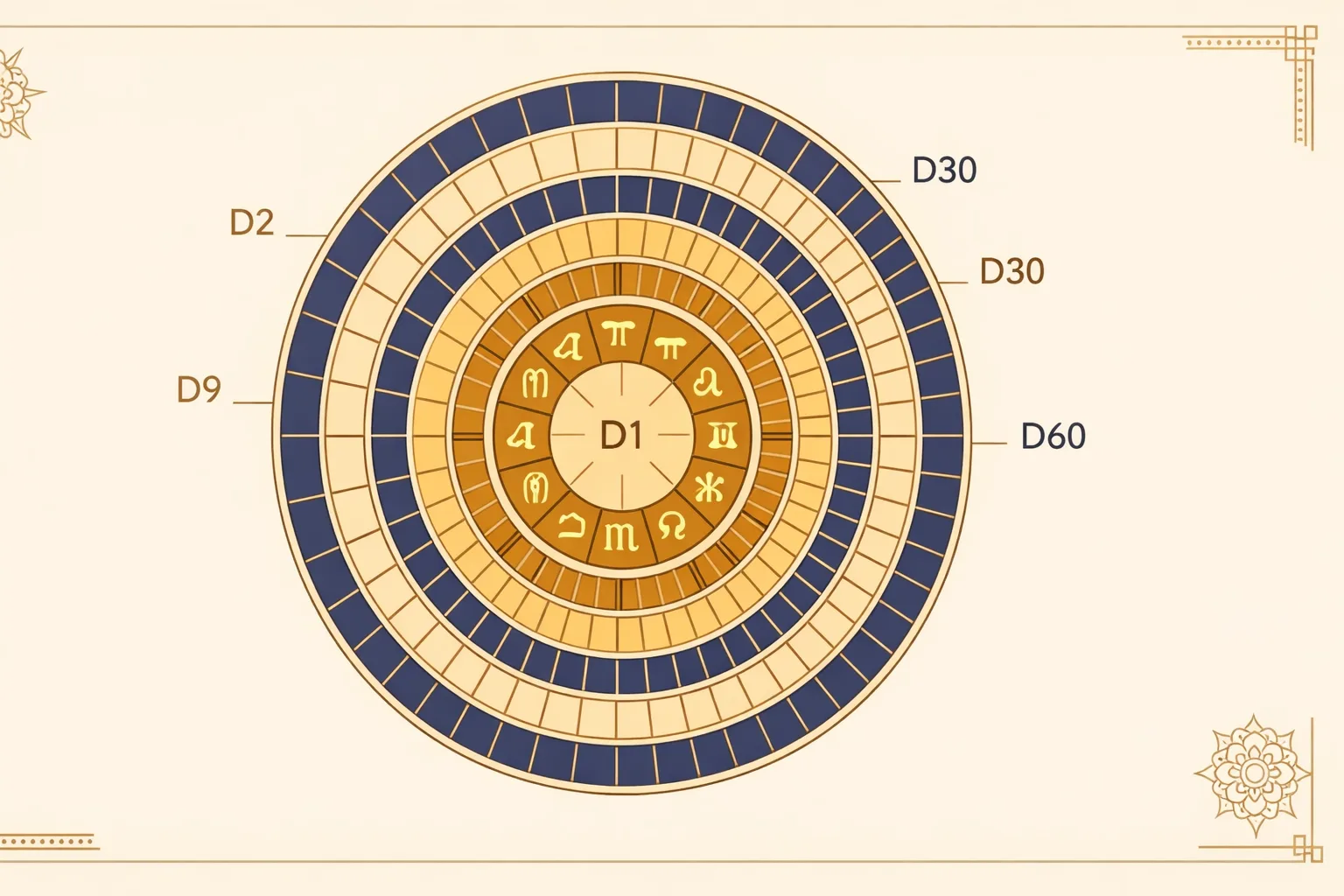
The birth chart alone tells you what. The divisional charts tell you how, how much, and in which area of life it actually plays out.
Most beginners learn Vedic astrology by reading the Rashi chart. That’s the D1, the foundation. But Parashara was clear in Brihat Parashara Hora Shastra that the D1 is a starting point, not the whole picture. Every significant area of life, such as wealth, marriage, children, career, longevity, past-life karma, has its own dedicated chart. These are the Shodashavarga, the sixteen divisional charts, and they form the analytical backbone of classical Vedic analysis.
This guide covers all sixteen. What each one is, what it reveals, how it’s calculated in principle, and how to read it without falling into the common traps. If you’re working with Jagannatha Hora or any serious software, every varga here is available at a click. The harder question is what to do with them once you see them.
Table of Contents
What Is a Divisional Chart?
A divisional chart, or varga, is a sub-chart derived mathematically from the Rashi chart by dividing each thirty-degree sign into smaller equal parts. The D2 divides each sign into two parts of fifteen degrees each. The D9 divides each sign into nine parts of three degrees twenty minutes each. The D60 divides each sign into sixty parts of just thirty arc-minutes each.
The planet’s position inside that sub-division, not its Rashi position, determines where it lands in the varga chart. A planet at two degrees Aries sits in the first Navamsa of Aries, which is Aries itself. The same planet at twenty-eight degrees Aries sits in the ninth Navamsa of Aries, which is Sagittarius. Same Rashi, completely different Navamsa.
This is why birth time accuracy matters so much for divisional analysis. A three-minute error in recorded birth time can shift planets across Navamsa boundaries in the D9, and can scramble the D60 entirely. Before doing any serious varga work, read the birth time rectification guide and, if KP methods appeal to you, the ruling planets rectification method.
How to Read a Divisional Chart: 5 Steps
- Start with the D1 Rashi chart. Identify the promise and indications for the life area in question. If the D1 shows nothing, the varga cannot manufacture a result.
- Open the varga that matches the question. D9 for marriage, D10 for career, D7 for children, D4 for property, D24 for education, D30 for misfortunes.
- Check the varga Lagna first. A weak varga Lagna makes every reading from that chart fragile, regardless of individual planet placements.
- Look for Vargottama planets. Any planet in the same sign across D1 and the relevant varga is exceptionally stable and reliable.
- Confirm with Dasha. Varga results only activate during supportive Mahadasha and Antardasha periods. A beautiful D10 without an activating Dasha stays theoretical.
Why Divisional Charts Exist: The Confirmation Principle
A varga chart does not predict something independently of the Rashi chart. This is the single most common misreading, and it’s worth stating plainly before going further.
The D1 shows the promise. The relevant varga confirms, modifies, or denies that promise. If the D1 shows strong career indications but the D10 Dasamsa is broken, the career promise weakens. If the D1 shows marriage difficulty but the D9 Navamsa is clean, the difficulty becomes survivable. You read them in sequence, never in isolation. Both can be cast in a few seconds with the navamsa calculator and the D10 chart calculator.
The same logic applies to yogas. A Raj Yoga visible in the Rashi chart only fully delivers if the participating planets remain strong across the relevant vargas, particularly the D9 and D10. This is why traditional analysis uses Vimshopaka Bala, a twenty-point composite strength score that evaluates a planet’s dignity across multiple divisional charts simultaneously. A planet strong in D1 but weak everywhere else gives superficial results. A planet strong across the Shadvarga set delivers substantially. For a related discussion of why promised yogas sometimes fail to fructify, see the article on yogas and the KP sub-lord answer.
The Grouping Systems: Shadvarga, Saptavarga, Dashavarga, Shodashavarga
Classical texts group the vargas into progressively larger sets for strength assessment. Each grouping is used for a specific depth of analysis. You don’t need to cast all sixteen for every question; you cast the ones that answer what’s being asked.
| Grouping | Number of Charts | Charts Included | Primary Use |
|---|---|---|---|
| Shadvarga | 6 | D1, D2, D3, D9, D12, D30 | Minimum set for basic strength evaluation |
| Saptavarga | 7 | Shadvarga + D7 | Extends analysis to progeny |
| Dashavarga | 10 | Saptavarga + D10, D16, D60 | Adds career, comforts, past-life karma |
| Shodashavarga | 16 | Full set: D1, D2, D3, D4, D7, D9, D10, D12, D16, D20, D24, D27, D30, D40, D45, D60 | Complete Parashara system for comprehensive analysis |
For most practical work, the Shadvarga handles strength assessment and the individual topical vargas (D7 for children, D10 for career, and so on) handle life-area interpretation.
Vargottama: When a Planet Holds Across Charts
When a planet occupies the same sign in the D1 and the D9, it’s called Vargottama, meaning “best in the divisions.” Such a planet is exceptionally stable and delivers consistent results regardless of dignity problems elsewhere. A Vargottama Saturn in a difficult sign is still more reliable than a well-placed Saturn that scatters across vargas.
Some practitioners extend Vargottama analysis to the D1-D10 pair for career, the D1-D7 for children, and the D1-D24 for education. Same principle: when a planet holds its ground across two related charts, its promise in that area is durable.
All 16 Divisional Charts at a Glance
A quick reference to every varga in the Shodashavarga, showing the division, the primary life area, and the life-domain focus. Use this as a lookup table; the detailed explanations follow in the next section.
| Chart | Sanskrit Name | Division | Life Area |
|---|---|---|---|
| D1 | Rashi | 30° per sign (full) | Body, self, overall life, personality |
| D2 | Hora | 15° per part | Wealth, accumulated assets, financial stability |
| D3 | Drekkana | 10° per part | Siblings, courage, initiative, short journeys |
| D4 | Chaturthamsa | 7° 30′ per part | Fixed assets, home, property, comforts |
| D7 | Saptamsa | 4° 17′ per part | Children, progeny, creative legacy |
| D9 | Navamsa | 3° 20′ per part | Marriage, spouse, dharma, planetary strength |
| D10 | Dasamsa | 3° per part | Career, profession, public standing |
| D12 | Dwadasamsa | 2° 30′ per part | Parents, ancestry, inherited karma |
| D16 | Shodasamsa | 1° 52′ 30″ per part | Vehicles, conveyances, luxuries |
| D20 | Vimsamsa | 1° 30′ per part | Spiritual progress, upasana, worship |
| D24 | Chaturvimsamsa | 1° 15′ per part | Education, learning, academic achievement |
| D27 | Bhamsa (Nakshatramsa) | 1° 6′ 40″ per part | Overall strength, resilience, vitality |
| D30 | Trimsamsa | Unequal (5/7/8/7/3) | Misfortunes, evils, vulnerabilities |
| D40 | Khavedamsa | 45′ per part | Maternal lineage, auspicious effects |
| D45 | Akshavedamsa | 40′ per part | Paternal lineage, character |
| D60 | Shashtiamsa | 30′ per part | Past-life karma, fine-tuning all indications |
The Sixteen Divisional Charts
What follows is the full Shodashavarga set. Each entry gives the division, the primary focus area, and a link to the complete guide for that chart. Read the ones relevant to your question, not all of them at once.
D1 — Rashi Chart (Birth Chart)
The foundation. One chart, thirty degrees per sign, twelve houses covering every domain of life. The D1 shows the overall promise, personality, body, and the general shape of destiny. Every other varga derives from it and confirms or modifies its indications. The twelve zodiac signs and nine grahas behave here as they do nowhere else, establishing the baseline for everything. Full guide: Rashi Chart D1 complete guide.
D2 — Hora Chart
Each sign split into two fifteen-degree halves, one ruled by the Sun, one by the Moon. This chart focuses on wealth, accumulated assets, and financial stability. Planets in the Sun’s hora lean toward self-earned wealth through effort and authority; planets in the Moon’s hora lean toward inherited or flow-based wealth through nurture and circulation. For the deeper analysis of wealth combinations, cross-reference the Dhana Yoga guide and the 2nd house significations. Full guide: Hora Chart D2 complete guide.
D3 — Drekkana Chart
Each sign split into three ten-degree parts. The Drekkana handles siblings, courage, short journeys, and personal initiative. The first drekkana is ruled by the sign itself, the second by the sign five houses ahead, the third by the sign nine houses ahead. Classical use also extends to health indications, with specific drekkana placements flagging accident-proneness or body-part vulnerabilities. Links naturally to the 3rd house. Full guide: Drekkana Chart D3 complete guide.
D4 — Chaturthamsa Chart
Each sign split into four parts of seven degrees thirty minutes. Governs fixed assets, home, property, vehicles, and general material comforts. A strong D4 supports property ownership and residential stability; a fragmented D4 suggests frequent relocation or difficulty holding real estate. Practitioners analyzing property purchase through KP use the D4 alongside the 4th cusp sub-lord for confirmation. See also the 4th house. Full guide: Chaturthamsa Chart D4 complete guide.
D7 — Saptamsa Chart
Each sign split into seven parts of four degrees seventeen minutes. The chart of children, progeny, and creative legacy. Saptamsa analysis is essential whenever the question involves conception, childbirth timing, or the number and well-being of children. Used in combination with Beeja and Kshetra Sphutas in the childbirth prediction framework. Connects to the 5th house. Full guide: Saptamsa Chart D7 complete guide.
D9 — Navamsa Chart
Each sign split into nine parts of three degrees twenty minutes. The most widely used varga after the D1, and arguably the most important single divisional chart. Traditionally the chart of marriage, spouse, and dharma, but it also functions as the strength-test for every planet in the Rashi chart. A planet well-placed in D1 but poorly placed in D9 delivers thinner results than the D1 alone suggests. Vargottama planets (same sign in D1 and D9) are especially reliable. For the marriage-focused reading, see the complete Navamsa D9 guide to spouse, married life, and timing.
D10 — Dasamsa Chart
Each sign split into ten parts of three degrees. The career and profession chart. For any serious analysis of professional direction, the D10 is as important to career as the D9 is to marriage. KP practitioners cross-check the 10th cusp sub-lord against D10 patterns before finalizing a career forecast. The D10 also clarifies the job versus business question and the likelihood of government employment. Connects to the 10th house. Full guide: Dasamsa Chart D10 complete guide.
D12 — Dwadasamsa Chart
Each sign split into twelve parts of two degrees thirty minutes. The chart of parents, ancestry, and inherited karma. Classical use emphasizes the 9th from Lagna in the D12 for the father and the 4th from Lagna for the mother, with sign and planetary placements revealing inherited strengths and unresolved family patterns. Useful for understanding why certain family dynamics repeat and why certain ancestral traits surface strongly in some natives and not others. Full guide: Dwadasamsa Chart D12 complete guide.
D16 — Shodasamsa Chart
Each sign split into sixteen parts of one degree fifty-two minutes thirty seconds. Governs vehicles, conveyances, and general comforts and pleasures. Modern usage extends this to major purchases beyond real estate, including premium vehicles, luxury items, and the quality of day-to-day material enjoyment. A supportive D16 indicates stable access to comforts; a damaged D16 points to repeated vehicle losses, accidents involving conveyances, or recurrent disruption of comfortable living conditions. Full guide: Shodasamsa Chart D16 complete guide.
D20 — Vimsamsa Chart
Each sign split into twenty parts of one degree thirty minutes. The chart of spiritual progress, worship, upasana, and chosen deity. For any native with a serious spiritual orientation, the D20 reveals the nature of the practice that suits them, the deity-form most likely to be accessible, and the depth of progress possible in this lifetime. Practitioners approaching questions of dharma and inner development benefit from reading the divine intervention factor alongside D20 analysis. Full guide: Vimsamsa Chart D20 complete guide.
D24 — Chaturvimsamsa Chart (Siddhamsa)
Each sign split into twenty-four parts of one degree fifteen minutes. The chart of education, learning, and academic achievement. The D24 reveals the field a native naturally masters, the depth of formal learning they can reach, and the obstacles that may interrupt education. Essential companion to the education Vedic astrology guide, particularly for questions about higher studies, competitive examinations, and research aptitude. Full guide: Chaturvimsamsa D24 complete guide.
D27 — Bhamsa Chart (Saptavimsamsa, Nakshatramsa)
Each sign split into twenty-seven parts of one degree six minutes forty seconds. The chart of overall strength and weakness. Unlike the topical vargas, the D27 is a general-purpose vitality and resilience reading. A planet strong in D27 endures pressure; a planet weak in D27 crumbles under adversity even if it looks fine elsewhere. Useful as a stress-test chart for any major life transition. Full guide: Bhamsa Chart D27 complete guide.
D30 — Trimsamsa Chart
Each sign split into thirty unequal parts ruled by the five non-luminous planets (Mars, Saturn, Jupiter, Mercury, Venus). Governs misfortunes, evils, vulnerabilities, and specific categories of difficulty. This is the chart to read when evaluating a native’s exposure to scandals, illnesses, enemies, and the forms of harm their karma makes them susceptible to. Pairs well with the psychological reading of difficult placements and the Badhaka versus Maraka distinction. Full guide: Trimsamsa D30 complete guide.
D40 — Khavedamsa Chart
Each sign split into forty parts of forty-five minutes. Focuses on maternal lineage and auspicious or inauspicious effects inherited through the mother’s line. Classical use is narrower than the popular vargas, but the D40 clarifies why some natives carry strong maternal patterns (both supportive and obstructive) that cannot be explained by the D1 alone. Full guide: Khavedamsa D40 complete guide.
D45 — Akshavedamsa Chart
Each sign split into forty-five parts of forty minutes. The counterpart to the D40, focused on paternal lineage, character, and inherited conduct. Reveals the ethical backbone inherited from the paternal line and the extent to which a native either continues or breaks with the family’s established character patterns. Full guide: Akshavedamsa D45 complete guide.
D60 — Shashtiamsa Chart
Each sign split into sixty parts of just thirty arc-minutes. Parashara considered the D60 so important that he gave it six units of weight in his strength-assessment scheme, more than any other varga including the D9. The chart of past-life karma and the fine-tuning of all other indications. Because each division is only half a degree wide, the D60 is brutally sensitive to birth time accuracy. An error of two minutes in recorded birth time can shift every planet in the D60. Handled correctly, it reveals the karmic residue shaping this incarnation in ways no other chart can. Connects to the Rahu-Ketu karmic axis and the larger question of fate versus free will. Full guide: Shashtiamsa D60 complete guide.
How to Actually Read a Varga Chart
The mechanics of casting a divisional chart are handled by software. The interpretive work is where most people stumble. A few principles keep the analysis honest.
Never read a varga in isolation. Start with the D1, identify the promise, then move to the relevant varga to confirm or qualify. If the D1 says nothing about a topic, the varga cannot manufacture a result from thin air. The varga refines what exists in the Rashi chart; it does not invent.
Check the varga Lagna first. Every divisional chart has its own ascendant, and the strength of the varga Lagna sets the tone for everything that follows. A weak D10 Lagna makes the entire career reading fragile regardless of individual planet placements.
Look for Vargottama planets. Any planet holding the same sign across D1 and the relevant varga is exceptionally reliable. These are the planets whose indications will actually deliver.
Assess dignity within the varga. A planet exalted in D1 but debilitated in D9 has a split nature, strong in general life but weak in the area the D9 governs. Treat the varga dignity as equally real to the Rashi dignity.
Remember that results still need Dasha activation. A beautiful D10 does not deliver a career peak outside of a Dasha period that supports it. Read the Vimshottari Mahadasha guide for how Dasha periods fire the promises visible in the vargas. A full interpretation framework is laid out in the divisional charts interpretation framework guide.
For practitioners working in the KP system, the relationship between divisional charts and the sub-lord theory deserves careful handling. KP’s core mechanism operates at the sub-lord level of the Rashi cusps, but vargas still function as corroborating evidence. A career forecast built on the 10th cusp sub-lord becomes more robust when the D10 agrees and weaker when it contradicts. See the sub-lord theory guide and the KP significators walkthrough for the integration logic.
Common Mistakes That Ruin Varga Analysis
Treating each varga as an independent horoscope is the single most frequent error. The varga is a lens, not a separate person. Planets do not act in the D10 the way they act in the D1; they act as strength-modified versions of their D1 behavior, specifically relevant to the area that varga governs.
Over-reliance on the D60 without supporting analysis is the second error. The D60 is powerful but also the most birth-time-sensitive chart of all. Using it as a headline instead of a confirmation tool produces unstable readings.
Ignoring Dasha is the third. A varga shows what can happen. The Dasha determines when, and whether in this lifetime at all. The two must be read together.
Mechanical rule-stacking is the fourth. Counting aspects and memorizing keyword lists produces the kind of flat reading that makes astrology feel like a horoscope column. Divisional analysis rewards pattern recognition and the willingness to hold several charts in view simultaneously before drawing a conclusion. For a discussion of why purely mechanical methods underperform, the article on why predictions fail is worth reading.
Divisional Charts in Jagannatha Hora
All sixteen vargas are accessible in Jagannatha Hora through the standard chart menu, with the software handling every calculation including the unequal Trimsamsa divisions and the delicate D60. Configuring the ayanamsa, chart style, and default house system correctly before running varga analysis avoids the most common source of beginner confusion. The JHora divisional charts tutorial walks through the exact menu paths, display options, and strength-table configurations. For KP-specific setup, which affects cusp calculations that feed into varga analysis when practitioners cross-reference, see the JHora KP configuration guide.
Where to Start
If you’re new to vargas, the honest order of learning is: master the D1, then the D9, then the D10. Those three charts cover the majority of client questions most practitioners face. The D7 becomes essential the moment childbirth questions appear. The D4 matters for property. The D24 matters for education. Everything else, including the famously difficult D60, can wait until the basics are steady.
Reading every varga on every chart is not mastery. It’s noise. Mastery is knowing which chart answers which question and reading that one carefully.
Frequently Asked Questions
How many divisional charts are there in Vedic astrology?
Parashara’s Brihat Parashara Hora Shastra defines sixteen primary divisional charts, collectively called the Shodashavarga. Some later traditions use extended sets of up to sixty charts for highly specialized analysis, but the sixteen-chart system handles the overwhelming majority of practical work.
Which divisional chart is most important?
The D9 Navamsa, after the D1 itself. Parashara and nearly every classical commentator treat the D9 as the strength-test for every planet in the Rashi chart, in addition to its specific role as the marriage chart. The D60 carries the highest weight in Parashara’s strength-scoring scheme but is too birth-time-sensitive to be the first varga a beginner learns.
Can divisional charts be read without the D1?
No. A varga confirms, modifies, or denies what the Rashi chart already indicates. If the D1 shows no promise of an event, no varga can create one. Reading a varga in isolation produces plausible-sounding but fundamentally unmoored interpretations.
Why does my D60 chart look completely different from my D9?
Because the D60 divides each sign into sixty parts of thirty arc-minutes each, while the D9 divides each sign into nine parts of three degrees twenty minutes. The D60 is extraordinarily sensitive to the exact recorded birth time. A difference of two minutes in birth time can shift every planet in the D60. If your D60 looks nothing like the rest of the chart, birth time rectification is the first step, not interpretation.
What is Vargottama?
A planet is Vargottama when it occupies the same sign in the D1 Rashi and the D9 Navamsa. Such a planet is considered exceptionally stable and delivers its indications reliably regardless of other dignity considerations. The term is sometimes extended to other D1-varga pairs, such as D1-D10 for career reliability.
What is Vimshopaka Bala?
Vimshopaka Bala is a twenty-point composite strength score that evaluates a planet’s dignity across a specified set of divisional charts (typically the Shadvarga, Saptavarga, Dashavarga, or full Shodashavarga). Higher Vimshopaka scores indicate planets whose promises are likely to actually deliver; lower scores indicate planets whose indications tend to stay theoretical.
Do I need accurate birth time for divisional charts?
Yes, and increasingly so as the division number rises. The D2 tolerates a few minutes of error. The D9 is sensitive to roughly three minutes. The D60 is sensitive to thirty seconds. For any serious work beyond the D9, birth time rectification is essential.
How do divisional charts relate to KP astrology?
KP’s core analytical mechanism operates at the sub-lord level of the Rashi cusps, not through divisional charts. However, serious KP practitioners still use vargas as corroborating evidence. A KP forecast based on cusp sub-lords becomes more robust when the relevant varga (D10 for career, D9 for marriage) agrees with the prediction, and more fragile when the varga contradicts.
Should I cast all sixteen vargas for every chart?
No. Cast the vargas relevant to the question being asked. For a marriage question, D1 and D9. For a career question, D1 and D10. For a childbirth question, D1 and D7. Casting all sixteen for every question produces noise, not insight.
What’s the difference between D9 Navamsa and D10 Dasamsa?
The D9 is the marriage and dharma chart, and doubles as the general strength-test for every planet. The D10 is specifically the career and profession chart. They answer different questions. A strong D9 does not guarantee career success, and a strong D10 does not guarantee marital happiness. Each chart is read for its specific domain.