You’ve downloaded JHora. You open the software and see charts everywhere. Planets in boxes. Numbers that don’t make sense. Lines connecting things you can’t identify. Tabs labeled with abbreviations you’ve never encountered. No idea what any of it means.
You’re not alone. Every KP astrologer—including the experts who now make uncannily accurate predictions—started exactly where you are right now. The difference between those who quit in frustration and those who became skilled practitioners usually comes down to one thing: whether they got the fundamentals right from the start.
Here’s what nobody tells beginners upfront: KP astrology is laser-precise. Unlike traditional astrology that gives vague timeframes like “sometime in the next two years,” KP narrows predictions down to specific months—sometimes even weeks. When you ask “Will I get married in 2026?” KP doesn’t say “probably.” It says “Yes, between March and May 2026” or “No, the chart shows 2028 is more likely.”
This precision is both KP’s greatest strength and its biggest trap for beginners. Because here’s the uncomfortable truth:
⚠️ CRITICAL WARNING: If your birth time is off by just 5 minutes, your prediction could be completely wrong. The sub-lord—the factor that determines whether an event actually happens or not—changes every few minutes. A birth time recorded as “around 10:30 AM” could mean 10:25, 10:30, or 10:35. Each of those times might give you a different sub-lord, and therefore a different answer. Use only birth times you are CERTAIN of. If you’re uncertain about your birth time, use our Birth Time Rectification Guide first. This isn’t optional—it’s essential.
There’s another problem nobody warns you about: JHora defaults to Traditional Vedic settings, NOT KP settings. Most beginners open JHora, see a chart that looks professional, and immediately start trying to make predictions. They don’t realize they’re reading Vedic calculations when they should be reading KP calculations. The house divisions are different. The planetary positions shift. The significators change. Everything looks similar on the surface but gives completely different answers underneath.
This single configuration mistake is responsible for most beginner failures in KP astrology. They make predictions, the predictions fail, and they conclude that either KP doesn’t work or they’re not talented enough. Neither conclusion is true. They simply had the wrong settings.
This guide prevents that mistake. By the end of this article, you’ll configure JHora correctly for KP astrology, understand how to read the significator table (without any manual calculations), and make your first real prediction—all in about 30 minutes.
Here’s exactly what we’ll cover in 5 specific steps:
- Install – Get JHora running on your computer (5 minutes)
- Configure – Set up the three critical KP-specific settings that most people get wrong (2 minutes)
- Identify – Find significators for your question using JHora’s built-in table (10 minutes)
- Time – Use Dasha periods to determine WHEN events will happen (5 minutes)
- Verify – Cross-check with Ruling Planets for confidence (5 minutes)
No previous astrology knowledge is required. No complicated calculations. No memorizing planetary positions or nakshatra boundaries. JHora handles all the technical complexity—your job is to learn how to ask the right questions and read the answers JHora provides.
By the time you finish this article, you’ll understand why KP astrology has developed such a devoted following among serious astrologers. The precision, the clarity, the ability to give concrete answers to concrete questions—it’s unlike any other system you’ve encountered.
Let’s begin.
What Is KP Astrology?
KP (Krishnamurti Paddhati) astrology was developed by Professor K.S. Krishnamurti in the 1960s in India. Professor Krishnamurti was a Vedic astrologer who became frustrated with one persistent problem: traditional Vedic astrology could tell you what might happen in your life, but it struggled to tell you when it would happen.
He spent decades researching, testing, and refining a system that prioritized timing precision above everything else. The result was Krishnamurti Paddhati—a method that divides the zodiac into much finer segments than traditional astrology, allowing for predictions accurate to specific months or even weeks.
KP vs. Vedic Astrology: A Clear Comparison
The easiest way to understand KP is to compare what each system tells you about the same question. Let’s take a common question: “Will I get married?”
| Traditional Vedic Answer | KP Astrology Answer |
|---|---|
| “Yes, marriage is indicated. Venus is well-placed and the 7th lord is strong. You’ll likely marry sometime in the next 2-3 years when Jupiter transits your 7th house.” | “Yes, marriage is promised. The 7th cusp sub-lord is Venus, signifying 2-7-11. Venus Bhukti runs March-August 2026. Marriage will happen between March-May 2026.” |
See the difference? Traditional Vedic gives you direction and a general timeframe. KP gives you direction plus a specific window. Both approaches have their place, but KP is designed for people who want actionable, time-bound predictions they can actually plan around.
Consider the practical implications. With traditional Vedic, you know marriage is coming “sometime in the next 2-3 years.” That’s useful information, but it doesn’t help you decide whether to renew your lease, plan a career move, or commit to a long-term project. With KP, you know marriage is coming “March-May 2026.” Now you can plan. You can time your decisions around that window.
If you need to know “Should I renew my apartment lease or will I be moving?”—KP can tell you whether that move is happening in the next 6 months or 18 months. That’s useful information that helps you make real decisions.
The Core KP Principle (Simplified)
KP astrology runs on one fundamental principle that powers every prediction you’ll ever make. Understand this, and you understand the heart of KP:
“A planet gives results of its STAR LORD, modified by its SUB LORD.”
Let’s translate this into plain English that actually makes sense:
- Star Lord = The nakshatra (constellation) where a planet sits. The 27 nakshatras divide the zodiac, and each is ruled by a specific planet. When a planet sits in a particular nakshatra, it primarily delivers results related to that nakshatra lord. This determines what the planet will deliver.
- Sub Lord = A finer subdivision within that nakshatra. Professor Krishnamurti divided each nakshatra into 9 unequal parts (called sub-divisions), each ruled by a different planet. The sub-lord acts as a “gatekeeper” that determines whether the planet will actually deliver what the star lord promises.
Think of it like a corporate hierarchy: The Star Lord is like your department head who assigns you projects. The Sub Lord is like the finance manager who decides whether those projects get budget approval. A great department head (favorable Star Lord) with a blocking finance manager (unfavorable Sub Lord) means projects get assigned but never get funded—they don’t actually happen.
Similarly, in KP astrology, the Star Lord might promise marriage, but if the Sub Lord signifies obstacles (like the 6th house of disputes or 12th house of loss), the marriage either doesn’t happen or faces significant problems.
This single principle powers all KP predictions. Once you understand how Star Lords and Sub Lords work together, you can predict virtually any event—marriage, career changes, relocations, health issues, financial gains, or losses.
Why JHora Is Perfect for Beginners
Jagannath Hora (JHora) is free, professional-grade astrology software developed by P.V.R. Narasimha Rao—himself a respected Vedic astrologer and software engineer. Here’s why it’s ideal for learning KP:
- It’s completely free – No trial periods, no premium features locked behind paywalls. Everything is available from day one.
- It calculates everything automatically – Star Lords, Sub Lords, significators, Dashas, transits—all computed for you. No manual math required.
- Professional astrologers use it – You’re learning on the same tool that working astrologers use with paying clients. No “training wheels” version.
- Excellent KP support – JHora has a dedicated K.P. tab with all the tables, charts, and calculations specific to Krishnamurti Paddhati.
Install JHora
Before configuring anything, you need JHora installed and running on your computer. This section is intentionally brief because we have detailed installation guides that cover every scenario.
Windows Users: Follow our complete JHora installation guide for step-by-step instructions with screenshots. The guide covers downloading from the official source, running the installer, handling common Windows security prompts, and initial setup. The entire process takes about 5 minutes.
Mac Users: JHora is a Windows application, but you can run it on Mac using Wine (a compatibility layer) or a virtual machine. See our Mac installation guide for detailed instructions on both methods. Wine is easier for most users; virtual machines offer better compatibility if Wine gives you trouble.
Linux Users: JHora runs well under Wine on most Linux distributions. The Windows installation guide includes a section on Wine setup for Linux.
Quick Installation Checklist:
- ☑ Downloaded JHora from the official source
- ☑ Ran the installer and completed setup
- ☑ Opened JHora and can see the main window with menu bar
- ☑ Can enter birth details and see a chart displayed
Got JHora running? Great. Now comes the critical step that most beginners skip or get wrong—and it’s the difference between predictions that work and predictions that fail.
THE 30-SECOND KP CONFIGURATION (MANDATORY!)
⚠️ This step separates correct predictions from failed ones. Do NOT skip this section. Do NOT skim it. Most beginner failures in KP astrology happen because this configuration step is wrong.
JHora is designed to support multiple astrology systems—Traditional Vedic, KP, Jaimini, Western, and more. When you first install it, it defaults to Traditional Vedic settings. These defaults are wrong for KP astrology. For KP to work correctly, you must change three specific settings. Miss even one, and your predictions will be systematically unreliable.
Step 1: Set House System to Placidus (Critical for House Cusps)
Navigation Path:
Open JHora → Click "Preferences" in menu bar → Select "Related to Calculations" → Click "House System" → Select "Placidus" (or "Semi-Arc") → Click "OK" to save
Why This Matters: JHora defaults to Equal Houses, which is the standard approach in traditional Vedic astrology. In Equal Houses, each house spans exactly 30 degrees starting from the Ascendant. Simple, but imprecise.
KP astrology uses the Placidus house system because it calculates house cusps based on the exact time and geographical location of birth. The resulting houses are unequal in size—some might be 25 degrees, others 35 degrees—but they precisely reflect the actual division of the sky at that moment and place. This precision is essential for accurate sub-lord calculations.
Real Example: Let’s say Mars is at 15° Aries in your chart. In Equal Houses (starting from, say, 3° Aries), Mars falls in the 1st house. But in Placidus, the 2nd house cusp might be at 12° Aries—meaning Mars is actually in the 2nd house, not the 1st. The 1st house represents self and personality. The 2nd house represents family and finances. Same planet, completely different interpretation.
The Consequence: If you leave this setting wrong, planets will appear in the wrong houses throughout your chart. Every significator you identify will be wrong. Every prediction you make will be based on incorrect house placements.
Step 2: Set Ayanamsa to Krishnamurti (Critical for Sub Lords)
Navigation Path:
Preferences → Related to Calculations → Ayanamsa → Select "Krishnamurti (KP)" or "KP New Ayanamsa" → Click OK
⚠️ Do NOT use “Lahiri” (the default) – Lahiri is for traditional Vedic astrology, not KP. Using Lahiri for KP predictions will give you wrong sub-lords.
Why This Matters: Ayanamsa is the angular difference between the tropical zodiac (used in Western astrology) and the sidereal zodiac (used in Vedic/KP astrology). Different ayanamsa values place the nakshatras (star constellations) at slightly different positions in the zodiac.
Professor Krishnamurti calculated a specific ayanamsa value for his system based on his research. The Krishnamurti ayanamsa differs from the commonly used Lahiri ayanamsa by about 6-7 arcminutes (roughly 0.1 degree). This seems tiny, but remember: sub-lord divisions are very small. A 6-arcminute difference can push a planet from one sub-lord to another.
| Lahiri (Default – WRONG for KP) | Krishnamurti (CORRECT for KP) |
|---|---|
| Standard Vedic ayanamsa value | Precise value calibrated for KP sub-lord system |
| Sub-lords will be calculated incorrectly | Sub-lords calculated as Prof. Krishnamurti intended |
The Consequence: Using Lahiri instead of Krishnamurti might give you the same planet positions but different sub-lords. Since the sub-lord is the “gatekeeper” that determines whether predictions manifest, wrong ayanamsa = wrong sub-lords = wrong answer. A chart that shows “marriage promised” with Krishnamurti might show “marriage denied” with Lahiri—same chart, opposite conclusion.
Step 3: Switch to KP View (Critical for Seeing Sub Lords)
Navigation Path:
In JHora main window → Look at the tab row at the BOTTOM of the screen (not the top menu) → Click the "K.P." tab → You should now see KP-specific data
What You’ll See: The “Basics” tab shows the standard Rasi (Vedic) chart—the familiar square or circular chart with planets in houses. This is what most people see and think they should analyze. Wrong. The “K.P.” tab shows what you actually need for KP predictions: house cusps listed with their exact degrees, each cusp’s sub-lord, and the all-important House Significators table.
Visual Checklist – Confirm You See These Elements:
- ☑ House Cusps listed with degree positions (e.g., “1st Cusp: 15°24’32” Leo”)
- ☑ Sub-lords listed next to each cusp (e.g., “Sub: Venus”)
- ☑ A “Significators” or “House Significators” table showing planets organized by house
If you don’t see these elements, you’re on the wrong tab. Go back and click “K.P.” at the bottom of the screen. Not the top menu—the tab bar at the bottom.
Troubleshooting: If the K.P. tab doesn’t exist or appears empty, verify that Steps 1 and 2 are complete. Also, JHora requires a chart to be loaded—enter any birth details (you can use your own) and the K.P. tab will populate with data.
Configuration Verification Checklist
Before moving forward, verify ALL four of these are correct:
- ☑ House System: Placidus (not Equal, Whole Sign, or Sripathi)
- ☑ Ayanamsa: Krishnamurti (KP) or KP New (not Lahiri, not Raman, not any other)
- ☑ Active Tab: K.P. (not Basics, not Planetary, not Divisional)
- ☑ Chart Shows: House cusps with degrees + Sub-lords + Significators table visible
⚠️ If ANY of these is wrong, go back and fix it NOW. Don’t proceed until all four are correct. These aren’t suggestions—they’re requirements.
Configuration done and verified? Excellent. Your JHora is now in “KP Mode.” The software will now calculate everything using the correct KP methodology. Let’s make your first prediction.
Pick Your First Prediction Question
KP astrology excels at answering specific, measurable questions about events. Not all questions are created equal—some questions KP can answer with precision, others it simply cannot address. Let’s make sure you pick a question that KP can actually handle.
What KP Can Answer (Good Questions)
- “Will I marry in 2026?” – Specific, time-bound, measurable event
- “When will I get promoted?” – Specific outcome with timing question
- “Will I relocate abroad this year?” – Clear event, defined timeframe
- “Will I clear my debt by 2026?” – Measurable financial outcome
- “Will this business partnership happen?” – Binary yes/no event
What KP Cannot Answer (Bad Questions)
- “Will I be happy in my marriage?” – Subjective; there’s no house for “happiness”
- “Is this the right person for me?” – Philosophical; not measurable
- “Should I change careers?” – Advisory; KP is analytical, not prescriptive
- “Will my life improve?” – Vague; what does “improve” mean objectively?
The Pattern: Good KP questions are specific, time-bound, and tied to a measurable outcome—an event that either happens or doesn’t happen. Bad questions are vague, emotional, or philosophical. KP handles the first type with precision. It cannot meaningfully address the second type.
The Marriage Question Example
Let’s use one of the most common KP questions for our walkthrough: “Will I marry in 2026?”
In KP astrology (and Vedic astrology generally), marriage is represented by three houses working together:
- 2nd House – Family. Marriage means adding a new family member and often combining families.
- 7th House – Spouse/Partner. This is the primary house of marriage and partnerships.
- 11th House – Fulfillment of desires. Marriage is a wish being granted, a goal being achieved.
When planets significantly connect to all three houses (the 2-7-11 combination), marriage is strongly indicated. When planets connect to contradicting houses—like 1 (self-focus), 6 (disputes), 10 (career obligations), or 12 (losses/separation)—marriage faces obstacles or delays.
This house-combination logic applies to all KP predictions. Here are some common examples:
- Career/Job: Houses 2-6-10-11 (income, service, profession, gains)
- Foreign Travel/Settlement: Houses 3-9-12 (short journeys, long journeys, foreign lands)
- Property/Vehicle Purchase: Houses 4-11 (property, fulfillment of desire)
- Childbirth: Houses 2-5-11 (family addition, children, fulfillment)
- Higher Education: Houses 4-9-11 (formal education, higher learning, success)
Your Turn: Pick ONE specific, time-bound question from the good examples above. Write it down somewhere—you’ll analyze this question step-by-step using JHora.
For this tutorial, we’ll continue with the marriage example, but the process works identically for any question—you just look at different house combinations. Career questions use 2-6-10-11. Foreign travel uses 3-9-12. Property purchase uses 4-11. The method stays the same.
Read Your First Significators Using JHora’s Table
Here’s the secret that makes KP accessible to beginners even without years of study: you don’t need to calculate significators manually. JHora performs all the complex calculations automatically. Your job is simply to learn how to read and interpret the table it provides.
Where to Find the Significators Table
In the K.P. tab (which you switched to in Section III), look for a section or table labeled “House Significators,” “Planetary Significators,” or “Significator List.” The exact label varies slightly between JHora versions, but you’ll see a table that organizes planets by which houses they signify.
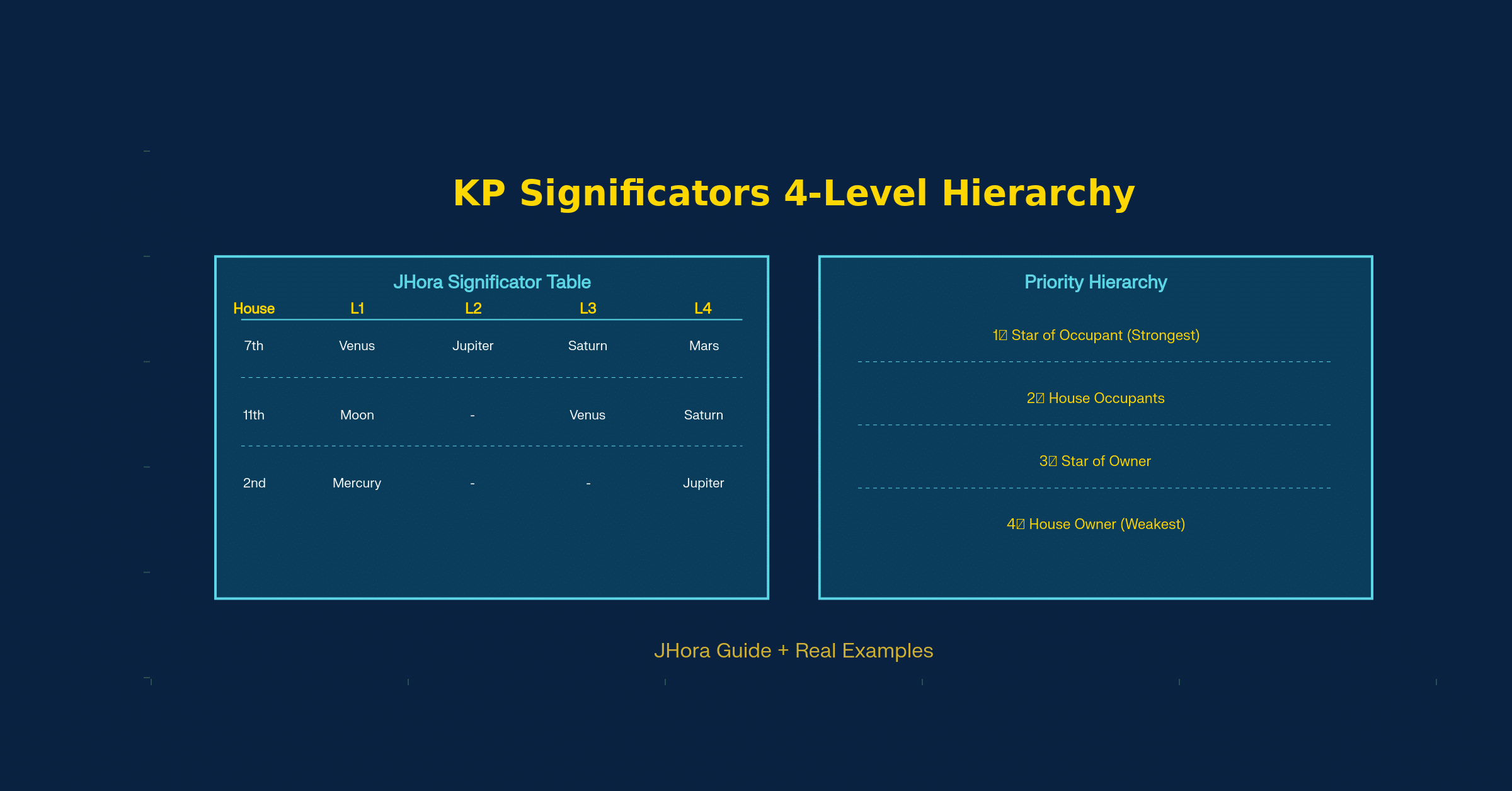
The table shows something like this (example data):
| House | A-Level | B-Level | C-Level | D-Level |
|---|---|---|---|---|
| 2nd | Mercury | — | Sun | Jupiter |
| 7th | Venus | Jupiter | Saturn | Mars |
| 11th | Moon | — | Venus | Saturn |
This table is your answer key. It shows which planets signify which houses, organized by their strength of connection (A through D levels).
What Each Column Means
- A-Level (Strongest): Planets sitting in the nakshatra (star) of a planet that occupies this house. These are your primary significators—the planets most strongly connected to delivering results of this house.
- B-Level (Strong): Planets physically occupying this house. Direct presence in a house creates a strong connection.
- C-Level (Moderate): Planets in the nakshatra of the lord (owner) of this house. Connection exists but is weaker than A or B levels.
- D-Level (Weakest): The house lord itself. Ownership alone creates the weakest significator connection.
Practical Rule for Beginners: Focus on A-Level first. If A-Level planets exist and favorably connect to your question’s houses, your prediction has a strong foundation. If A-Level is empty or connects unfavorably, the prediction is weaker or denied.
How to Read It: Marriage Question Example
Question: “Will I marry in 2026?”
Relevant Houses: 2nd (family), 7th (spouse), 11th (fulfillment)
Step-by-Step Process:
- Find the 7th house row in your significators table
- Note the A-Level planet(s) listed (e.g., Venus)
- Repeat for the 2nd house (e.g., Mercury)
- Repeat for the 11th house (e.g., Moon)
- You now have your primary marriage significators: Venus, Mercury, Moon
Interpretation: In this example, Venus, Mercury, and Moon all appear at A-Level for the marriage houses. This means marriage is PROMISED by this chart. The next step is determining when—which we’ll cover in the timing section.
Notice how different planets signify different houses. In our example, Venus is the strongest significator for the 7th house (spouse), Mercury for the 2nd house (family), and Moon for the 11th house (fulfillment). When all three of these planets run their Dasha periods simultaneously or sequentially, the marriage event has maximum potential to manifest.
Also note that the same planet can signify multiple houses. If Venus appears as an A-Level significator for both the 7th AND 11th houses, it becomes an especially powerful marriage indicator. When Venus Dasha runs, it activates both spouse-related matters (7th) and wish-fulfillment (11th) at the same time—creating ideal conditions for marriage.
What If You Don’t See Clear A-Levels?
Don’t panic. Not every chart has A-Level significators for every house. Here’s how to interpret different scenarios:
- Only B/C/D levels present: Event might happen but with delays or conditions attached
- Empty columns for some houses: Timing might be beyond your question period (2027-2028 instead of 2026)
- Negative houses also strongly signified: Look for significators of 1, 6, 10, or 12—these indicate obstacles
This is more realistic than a simple binary YES/NO. Real life has conditions, and KP shows you those conditions.
For example, if you see strong A-Level significators for marriage houses (2, 7, 11) but also see the same planets signifying the 8th house (obstacles, transformations), the interpretation becomes nuanced: marriage is indicated but may come with challenges, or might involve significant life changes. Perhaps the partner comes from a different background, or the marriage requires relocation, or there are family objections to overcome. KP shows you the complete picture, not just a simplified answer.
The Sub-Lord Safety Check
Here’s one extra verification that separates good predictions from mediocre ones:
Look at the A-Level planets you identified. Now check which houses their sub-lords signify. JHora shows planet sub-lords in another section of the K.P. tab.
- If the planet’s sub-lord signifies 8th or 12th house → The prediction might get blocked or negated
- If the planet’s sub-lord signifies the same favorable houses (2, 7, 11) → The prediction is doubly confirmed
For a comprehensive understanding of sub-lords and the complete 4-level significator hierarchy, see our KP Significators Deep Dive Guide.
Time Your Prediction (The WHEN)
You’ve identified what the chart promises. Now you need to find when it will happen. This is where the Dasha system enters—KP’s timing mechanism.
Understanding the Dasha System (Simply)
In Vedic and KP astrology, life is divided into planetary periods called Dashas. Think of it as different planets taking turns “ruling” portions of your life. During a planet’s Dasha period, events related to that planet’s significations become active and manifest in your life.
The Dasha system is based on the Moon’s position at birth. Depending on which nakshatra the Moon occupied, you start life in a particular planet’s Mahadasha (major period). From there, the sequence proceeds through all nine planets in a fixed order, with each planet ruling for a predetermined number of years.
The Mahadasha periods are: Sun (6 years), Moon (10 years), Mars (7 years), Rahu (18 years), Jupiter (16 years), Saturn (19 years), Mercury (17 years), Ketu (7 years), and Venus (20 years). Within each Mahadasha, there are Bhuktis (sub-periods) and within each Bhukti, there are Antaras (sub-sub-periods). This creates a layered timing system of remarkable precision.
JHora displays your current Dasha prominently. You’ll see something like:
Current Dasha:
  Mahadasha: Saturn (until 2031)
  Bhukti: Jupiter (until March 2026)
  Antara: Venus (until December 2025)
This tells you: Saturn is the major period lord (Mahadasha), Jupiter is the sub-period lord (Bhukti), and Venus is the sub-sub-period lord (Antara). Each level gets progressively shorter and more specific in timing.
The Simple Timing Rule
Events manifest when your significator planet’s Dasha period runs.
From our marriage example, let’s say Venus was your strongest marriage significator (A-Level for 7th house). Look at your Dasha sequence and find when Venus appears:
- If Venus Bhukti or Antara runs in 2026 → Marriage likely happens in 2026
- If Venus period starts only in 2028 → Marriage likely happens in 2028, not 2026
- If Venus period already passed → Check when the next strongest significator period runs
Real Example:
Current: Saturn Mahadasha, Jupiter Bhukti (ending March 2026)
Your marriage significator: Venus
Venus Bhukti begins: April 2026

Conclusion: Marriage most likely April-December 2026
(when Venus Bhukti operates)
Key Insight: The chart shows PROMISE (whether something can happen). The Dasha shows TIMING (when it will happen). Both must align for accurate prediction.
The Ruling Planets Verification
Ruling Planets is a KP verification technique that tells you whether a prediction is “ripe” to manifest at the time you’re doing the analysis.
Simplified Process:
- Note the 5 ruling planets shown in JHora (based on current Ascendant, Moon sign, day lord, etc.)
- Check: Do these ruling planets include your significators?
- If YES → Prediction is considered “fruitful” (likely to manifest as predicted)
If NO → The timing might be off, or the question needs further analysis.
Practical Note for Beginners: You don’t need to master Ruling Planets right now. Just know it exists as a confirmation tool. After making a few predictions, come back and learn it properly—you’ll appreciate why it matters.
For the complete Ruling Planets methodology, see our KP Ruling Planets Guide (section on ruling planets verification).
Common Mistakes Beginners Make
These aren’t theoretical mistakes. They’re the exact, specific reasons why beginner KP predictions fail. If your first prediction misses, review this list before assuming KP doesn’t work or that you lack talent.
Mistake 1: Using Lahiri Instead of Krishnamurti Ayanamsa
What Goes Wrong: Sub-lords are calculated approximately 6-7 arcminutes off. This small difference can push planets into different sub-lord territories, completely inverting your prediction.
The Fix: Verify in Preferences → Related to Calculations → Ayanamsa. It must say “Krishnamurti (KP)” or “KP New Ayanamsa.” Not Lahiri.
Real Consequence: A chart showing “marriage strongly promised” with Krishnamurti might show “marriage denied or heavily delayed” with Lahiri. Same chart, opposite conclusion, because the sub-lords shifted.
Mistake 2: Reading “Basics” Tab Instead of “K.P.” Tab
What Goes Wrong: You’re reading the traditional Vedic chart instead of the KP-specific calculations. House cusps differ. Significators differ. Everything looks plausible but is wrong for KP analysis.
The Fix: Look at the tab bar at the BOTTOM of JHora’s window. Click “K.P.” tab. Confirm you see house cusps with sub-lords and the significators table.
Real Consequence: You identify wrong significators, create a prediction based on incorrect data, and conclude that KP failed when actually you never used KP data in the first place.
Mistake 3: Using Equal Houses Instead of Placidus
What Goes Wrong: House cusps are calculated using the simpler Equal House system. Planets that should be in one house appear in a different house.
The Fix: Preferences → Related to Calculations → House System → Select “Placidus” (or Semi-Arc).
Real Consequence: A planet you think is in the 5th house (children, creativity, romance) is actually in the 4th house (home, mother, property) under Placidus. Your entire analysis points to the wrong life area.
Mistake 4: Ignoring Birth Time Uncertainty
What Goes Wrong: You make a technically correct prediction for the given birth time, but the birth time itself is inaccurate. The chart doesn’t represent the actual person.
The Fix: If birth time is uncertain (recorded as “around 10 AM,” “morning,” or rounded to nearest hour), use our Birth Time Rectification Guide to verify the birth time before making predictions.
Real Consequence: Your prediction is mathematically correct for the wrong chart. It’s like giving perfect driving directions to the wrong address.
Mistake 5: Manually Reading Significators from Chart
What Goes Wrong: Instead of using JHora’s calculated significator table, you try to visually determine significators by looking at the chart wheel. Human error, misreading positions, forgetting which nakshatra a planet is in.
The Fix: ALWAYS use the “House Significators” table that JHora provides. Don’t try to calculate or visually determine significators yourself.
Real Consequence: You think Venus is the 7th house significator when it’s actually Saturn. Wrong significator = wrong timing = wrong prediction.
Document & Track Your First Prediction
This step separates serious students from casual hobbyists. Write down your predictions and track whether they come true. This practice builds your skill faster than anything else.
Create Your Prediction Record
Use this template for every prediction you make:
Date of Prediction: [Today's date]
Question: [Your specific, time-bound question]
Significators Found: [List A-Level planets for relevant houses]
Running Dasha: [Current Mahadasha/Bhukti/Antara]
Predicted Timing: [Month/year range when event should occur]
Confidence Level: [High / Medium / Low]
Actual Outcome: [Fill in after the predicted period passes]
Why It Succeeded/Failed: [Your analysis]
Reality Check Your Prediction
Before finalizing your prediction, ask yourself:
- Does this prediction make sense given current life circumstances?
- Is the timing reasonable? (Someone asking about marriage in 3 months who isn’t dating anyone should raise questions)
- If something feels wrong, go back and verify configuration and significators
Document Outcomes (Most Important Step)
After the predicted timeframe passes, UPDATE your template with the actual outcome. Did the event happen? Did it happen within your predicted window? What was different from your prediction?
This builds your personal accuracy database. After 10 predictions, you’ll see patterns. Perhaps you excel at career predictions but struggle with relationship timing. Perhaps your accuracy improves when you double-check sub-lords. These patterns are invaluable for your growth as a KP practitioner.
Your Next Steps
You’ve just made your first KP prediction. You’ve done what 90% of astrology students never do—actually applied theory to a real question using real data.
If You’re Uncertain About Birth Time
KP’s precision is both its strength and its vulnerability. If your birth time is even 5 minutes off, predictions can fail. If your birth certificate says “10:30 AM” but the actual time was “10:25 AM” or “10:35 AM,” your entire analysis might be wrong.
Action: Before making more predictions, use our Complete Birth Time Rectification Guide. It walks you through verifying your birth time to ±1-2 minute accuracy using past life events as reference points.
If You Want Deeper Understanding
Recommended next reads to expand your KP knowledge:
- KP Setup Guide – Complete JHora configuration including advanced settings
- KP Significators Deep Dive – Master the 4-level hierarchy and sub-lord analysis
- KP Accuracy Exposed – Why predictions fail and systematic fixes
If You Want to Answer Questions Without Birth Time
Our KP Horary 1-249 Guide teaches you to answer specific questions using horary astrology—no birth time required. Perfect for client questions where exact birth time is unknown.
Track 10 Predictions
Your confidence and accuracy grow with systematic practice. Set a goal: make 10 documented predictions over the next 3-6 months. Track every one with the template provided. After 10, analyze your results. What patterns emerge? Where do you succeed? Where do you struggle? This feedback loop is how every expert KP astrologer built their skill.
Conclusion
Let’s summarize what you’ve learned in this guide:
- The Core KP Principle: Planets deliver results of their Star Lord, modified by their Sub Lord
- Critical Configuration: Placidus house system + Krishnamurti ayanamsa + K.P. tab active
- Reading Significators: Use JHora’s table—focus on A-Level planets for relevant houses
- Timing Predictions: Events happen when significator planet Dasha periods run
- Top 5 Mistakes: Configuration errors that derail most beginners
This is just the beginning. KP astrology has depth you haven’t seen yet—advanced transit analysis, multiple-event predictions, rectification techniques, horary applications. But you now have the solid foundation that makes everything else possible.
Remember: every expert KP astrologer started exactly where you are now. They made their first prediction, tracked the result, learned from their mistakes, and gradually improved their accuracy. The system works—it’s been proven by thousands of practitioners over decades. Your job is simply to follow the methodology consistently and learn from each prediction.
Don’t be discouraged if your first few predictions aren’t perfect. Even experienced astrologers don’t achieve 100% accuracy—that’s the nature of any predictive system dealing with complex life events. What matters is that your accuracy improves over time as you refine your technique and deepen your understanding.
The only way forward is practice. Make your first prediction using the process in this guide. Document it carefully. Return in 6 months and evaluate whether it came true. That’s how you learn KP—by using it, tracking results, and continuously improving.
Frequently Asked Questions
Q: “My prediction failed. Why?”
A: Most likely cause: wrong configuration settings. Verify: (1) Ayanamsa is Krishnamurti, not Lahiri; (2) House System is Placidus, not Equal; (3) You’re reading K.P. tab, not Basics. If all three are correct, your birth time is probably inaccurate—use our Birth Time Rectification Guide to verify.
Q: “Do I REALLY need accurate birth time?”
A: Absolutely yes. KP is laser-precise—birth time off by 5 minutes means wrong sub-lords, which means wrong predictions. If uncertain, use the Birth Time Rectification Guide first. This isn’t optional.
Q: “How long until I master KP?”
A: Configuration mastery: 10-15 minutes (this article). Making reliable predictions: 2-3 months of practice (10+ documented predictions). True expertise: 1-2 years of consistent practice. Everyone progresses differently—consistent practice and outcome tracking accelerate learning.
Q: “Should I learn Vedic astrology first?”
A: No, you can start directly with KP. However, understanding basic Vedic concepts (houses, planets, nakshatras) provides helpful context. The two systems share the same foundation—KP adds the precision layer on top.
Q: “Is KP better than traditional Vedic astrology?”
A: Different tools for different purposes. KP excels at event timing: “When will I get married?” Traditional Vedic excels at life themes and psychological insight: “What kind of partner suits me?” Many professional astrologers use both systems depending on the question type.
Q: “Can beginners really get accurate predictions?”
A: Yes—if configuration is correct and birth time is accurate. Expect 60-70% accuracy initially. After 10-20 documented predictions with careful analysis of successes and failures, you’ll improve to 80%+. The key is systematic practice and honest evaluation of results.