The Rashi chart (D1) is the foundational birth chart in Vedic astrology, showing the position of the Lagna, the nine planets, and the twelve houses at the moment of birth. It defines the core life pattern and serves as the base from which all sixteen divisional charts derive their meaning and predictive power.
Most interpretation failures trace back to a D1 read too quickly. Beginners learn the chart in a week and then move on, treating it as a stepping stone to the “real” work in Navamsa or Dasamsa. That habit produces unreliable readings for years afterward.
In professional chart analysis, the D1 is never skipped. Every dependable prediction begins with validating the promise shown here before moving to divisional charts. A chart that the D1 cannot support, no varga can rescue. A promise that the D1 clearly shows, no varga can fully deny.
This guide covers what the Rashi chart is, what each element reveals, how to read it without falling into the usual traps, and how it anchors the sixteen divisional charts that refine its indications.
Table of Contents
What Is the Rashi Chart?
The Rashi chart is the map of the sky at the moment of birth, drawn from the perspective of the birthplace. It shows which zodiac sign was rising on the eastern horizon at the time of birth (the Lagna or ascendant), where each of the nine grahas was positioned, and how the twelve houses of life divide around the Lagna.
“Rashi” means sign. The D1 is called the Rashi chart because it uses the full thirty-degree span of each sign without subdividing it. Every other varga in the Shodashavarga system is a further division of this foundational chart.
The word “D1” indicates that each sign is divided into one part, meaning no division at all. It’s the baseline against which every other varga is compared.
Birth time accuracy matters here, but not as sharply as it does in the higher vargas. A ten-minute error in birth time rarely shifts the D1 significantly unless the ascendant is close to a sign boundary, in which case the entire chart shifts by thirty degrees of house division. If your recorded birth time is uncertain, the birth time rectification guide walks through the standard methods.
The Five Elements of the D1
A complete reading of the Rashi chart requires five components, each contributing a different layer of information.
| Element | What It Shows | Why It Matters |
|---|---|---|
| Lagna (Ascendant) | Rising sign at birth | Anchors the entire chart; defines the 1st house |
| 12 Houses | Life domains (self, wealth, marriage, career, etc.) | Each house represents a specific area of experience |
| 12 Signs | Zodiac signs occupying each house | Signs modify how the house expresses itself |
| 9 Planets (Grahas) | Planetary placements and degrees | Planets act as the active forces inside houses |
| 27 Nakshatras | Lunar mansions behind each planet | Nakshatra lords drive timing through Dasha |
A reading that works with fewer than these five elements is incomplete. Most popular astrology content stops at planets in signs, which is why those readings often feel generic. The house overlay is what makes the chart personal, and the nakshatra layer is what makes timing possible. Each of the 27 nakshatras has its own planetary lord that feeds directly into the Vimshottari Dasha system.
How to Read the Rashi Chart: 6 Steps
- Identify the Lagna. Which sign is on the 1st house cusp? This anchors every other house.
- Note the Lagna lord. The planet ruling the Lagna sign is the chart’s primary indicator for the self. Where it sits matters enormously.
- Assess the Moon’s placement. The Moon shows the mind and emotional nature. Its sign, house, and nakshatra shape how the native experiences life.
- Check each planet’s dignity. Is it exalted, debilitated, in own sign, or neutral? Dignity determines strength.
- Read house groups, not single houses. For any life question, check the relevant group (e.g., 2-7-11 for marriage, 2-6-10-11 for career).
- Overlay the Dasha. The running Mahadasha and Antardasha determine which promises are active now.
Why the Lagna Matters Most
Every reading in Vedic astrology begins with the Lagna. It’s not just the 1st house; it’s the reference point from which every other house is counted. Change the Lagna and the entire house structure shifts, which is why two people born minutes apart with different ascending signs can have radically different life patterns despite near-identical planetary positions.
Want this read in your own chart?
Reading your own chart is good for learning and unreliable for deciding. Not because the technique is difficult, but because nobody has distance from their own life. You will weight the placement that confirms what you already suspect.
This page gives you the general reading for that placement. What it cannot do is weigh it against the rest of your chart, or tell you which version of it is yours.
Send me your birth details and your questions on WhatsApp. I can usually take the call the same day, and if there is no slot free we will arrange a time that suits you. It runs 30 to 40 minutes by voice, in English, Hindi or Punjabi, and you can follow up by message afterwards.
Message on WhatsAppPersonal reading with Parminder Chahal · ₹2,100
Payment using UPI , international clients through service like Remitly.
The Lagna shows the body, the self, the native’s entry point into life. The planet ruling the Lagna sign, called the Lagna lord or Lagnesh, carries the thread of the native’s identity through the chart. If the Lagna lord is strong and well-placed, the person has a stable sense of self and the capacity to direct their life. If the Lagna lord is weak or afflicted, the native struggles to integrate the chart’s other indications into a coherent life direction.
For a complete reading of each rising sign, the zodiac signs overview covers how each sign behaves as the Lagna. The 1st house guide goes deeper into the Lagna’s function as the house of self.
House Groups and Their Significations
Classical Vedic astrology never reads a single house in isolation for major life events. Every important domain is governed by a group of houses that together indicate the matter. This is the single most important shift that separates beginner-level reading from practitioner-level analysis.
| Life Area | House Group | Logic |
|---|---|---|
| Marriage | 2, 7, 11 | Family, partner, fulfillment |
| Career | 2, 6, 10, 11 | Income, service, profession, gains |
| Children | 2, 5, 11 | Family, progeny, fulfillment |
| Education | 4, 5, 9 | Schooling, intelligence, higher learning |
| Wealth | 2, 5, 9, 11 | Accumulation, speculation, fortune, gains |
| Property | 4, 11 | Fixed assets, gains |
| Foreign Travel | 3, 9, 12 | Short trips, long journeys, distant lands |
| Separation/Divorce | 6, 10, 12 | Disputes, public event, loss |
| Spiritual Life | 5, 9, 12 | Devotion, dharma, liberation |
An event usually requires connection between the relevant house group through planetary significators or through Dasha activation. This is the logic KP astrology formalizes through sub-lords, but the underlying principle is pre-KP and traces directly to Parashara. For the KP-specific application, see the KP significators guide.
How Planets Behave in the D1
Each of the nine planets carries a specific nature, but its expression in a given chart depends on three factors: the sign it occupies, the house it sits in, and the nakshatra it falls under.
The Sun rules authority, father, soul, and self-expression. Strong when in Leo, Aries, or elevated houses. Weak when combust, debilitated in Libra, or afflicted by nodes.
The Moon rules mind, mother, emotional life, and public reception. Strong when bright and waxing, in Taurus or Cancer. Weak when dark, debilitated in Scorpio, or hemmed between malefics.
Mars rules energy, courage, property, brothers, and conflict. Strong in Aries, Scorpio, Capricorn, or the 10th house. Weak when debilitated in Cancer or in the 4th house unless supporting Ruchaka Yoga.
Mercury rules intellect, speech, trade, and communication. Strong in Virgo, Gemini, and angular houses. Weak when combust by the Sun or afflicted.
Jupiter rules wisdom, dharma, children, wealth, and expansion. Strong in Cancer (exalted), Sagittarius, Pisces, or the 1st, 5th, 9th houses. Weak when debilitated in Capricorn.
Venus rules marriage, pleasure, luxury, and art. Strong in Pisces (exalted), Taurus, Libra, or the 4th, 7th houses. Weak when debilitated in Virgo or combust.
Saturn rules discipline, longevity, service, and delay. Strong in Libra (exalted), Capricorn, Aquarius, or the 3rd, 6th, 11th houses. Weak when debilitated in Aries or afflicting the 1st, 5th, 9th houses.
Rahu and Ketu are shadow planets that act as agents of the sign lords they occupy. Their effects depend heavily on which house and sign they sit in, and on which planet they conjoin. The Rahu-Ketu karmic axis article covers their psychological dimension in depth.
The Promise Principle
This is the single most important concept for reading the Rashi chart correctly: a chart can only deliver what it promises.
If the D1 shows no indication of marriage (weak 7th house, afflicted 7th lord, no connection between marriage houses), no transit or Dasha can create a marriage. It can suggest relationships, short-term partnerships, or repeated engagement, but not the full promise of marriage.
This principle is what separates rule-based astrology from wishful thinking. Every reading must first establish what the chart promises, and only then move to the timing question. The order is: promise first, timing second, never the reverse.
Practitioners who skip this step and go straight to Dasha timing produce the unreliable predictions that give astrology a bad reputation. A beautiful Venus Dasha cannot manufacture a marriage in a chart where the 7th house has no support. For a deeper discussion of why the promise principle is non-negotiable, the pillar article on why astrological predictions fail covers the failure modes in detail.
Common Mistakes to Avoid
Reading single houses in isolation is the most common error. Marriage is not determined by the 7th house alone, career is not determined by the 10th alone, and children are not determined by the 5th alone. Always read the relevant house group.
Over-weighting sign placement at the expense of house placement is the second. A planet in its exaltation sign but in a difficult house often gives less than a planet in an ordinary sign but in a supportive house. House placement usually trumps sign placement for event delivery.
Ignoring the nakshatra layer is the third. The 27 nakshatras carry independent significations and their lords drive the entire Vimshottari Dasha system. A reading that stops at signs and houses misses the timing mechanism entirely.
Mixing systems is the fourth. Reading a Rashi chart in the Parashari framework while casually adopting KP rules, or vice versa, produces internally inconsistent results. Pick a framework and follow it through. For the distinction between the two, see the KP vs Vedic astrology comparison.
Treating the D1 as the complete chart is the fifth. The D1 shows what is promised. The divisional charts confirm, modify, or deny that promise. The Vimshottari Mahadasha times its delivery. A reading based on the D1 alone is incomplete.
From D1 to the Divisional Charts
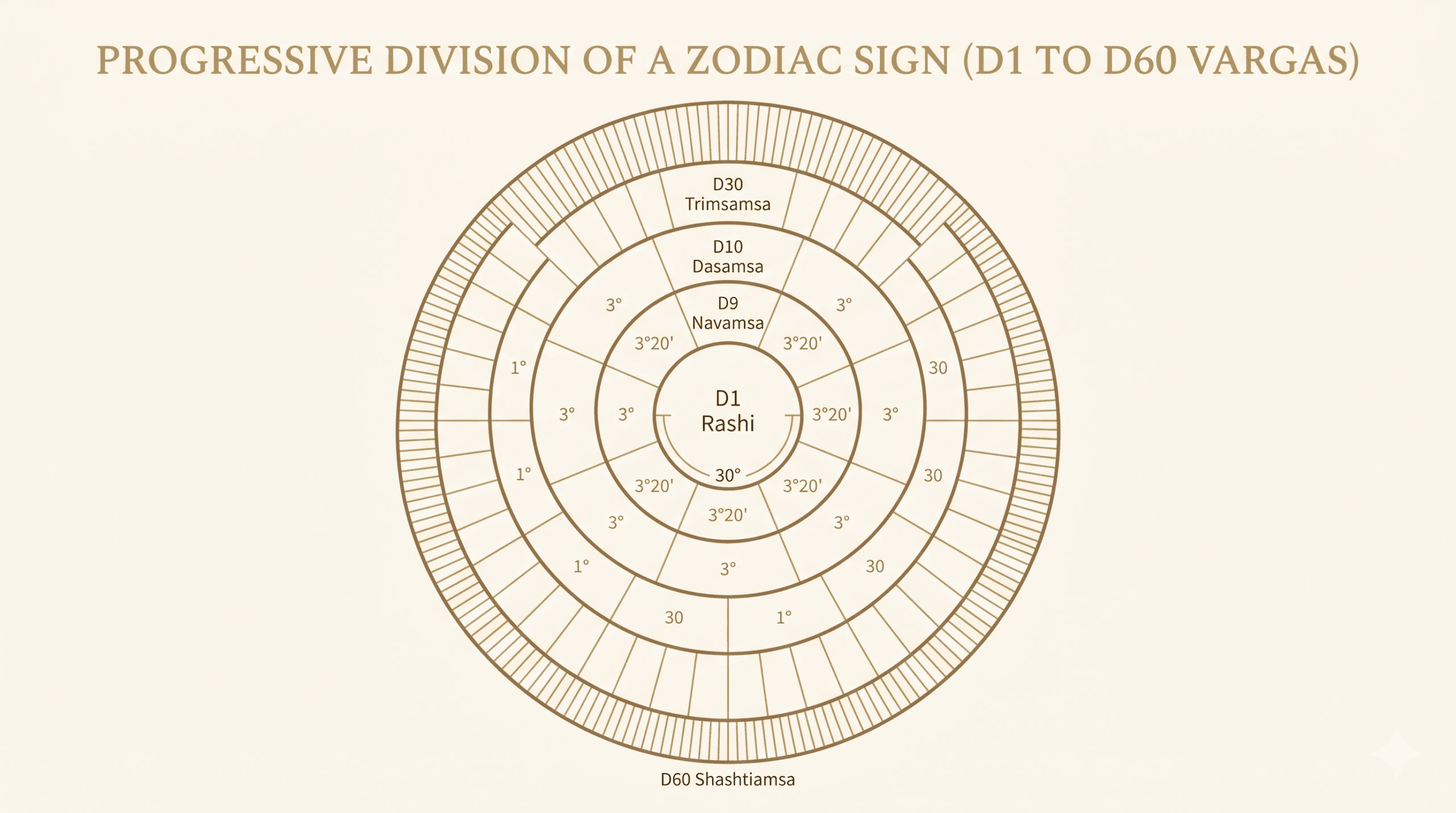
Every varga in the Shodashavarga system derives mathematically from the D1. The D9 Navamsa divides each sign into nine parts. The D10 Dasamsa divides each sign into ten parts. The D60 Shashtiamsa divides each sign into sixty parts. In every case, the D1 provides the planetary positions that feed into the varga calculation. How the D1 Rashi chart divides into higher vargas like D9, D10, and D60.
The practical consequence is that the D1 must be accurate before any varga reading is reliable. If the birth time is wrong, every subsequent varga carries the same error, compounded by the finer division. A five-minute error in the D1 becomes a severe distortion in the D60.
Once the D1 is established, the varga reading follows a clear logic. The D1 shows the promise; the relevant varga confirms or modifies it. Where the D1 shows what is possible, the D9 Navamsa for marriage analysis shows the strength of that possibility in the marriage domain. For career, move from the D1 10th house to the D10 Dasamsa for career prediction. For children, move from the D1 5th house to the D7 Saptamsa for progeny analysis. For wealth, move from the D1 2nd house to the D2 Hora wealth chart.
The full integration framework is covered in the divisional charts interpretation framework.
Rashi Chart in Jagannatha Hora
The D1 is the default chart displayed when any horoscope is opened in Jagannatha Hora. The software offers multiple chart styles (North Indian, South Indian, East Indian) and multiple ayanamsa options, with Lahiri being the standard for most Parashari work. For KP-specific work, the Krishnamurti ayanamsa (KP New) is the correct choice.
Before relying on the D1 for any serious reading, confirm three settings: the ayanamsa matches the system being used, the house system is Placidus for KP or Whole Sign for most Parashari traditions, and the chart style matches the practitioner’s training. The JHora settings and ayanamsa configuration guide walks through each option. For KP-specific configuration, the JHora KP setup guide is the complete reference.
Where to Go Next
Once the D1 reading is steady, the natural progression is into the divisional charts that refine its indications. Each one sharpens a specific life area.
- Navamsa (D9) — marriage, spouse, dharma, and the strength-test for every planet in the D1.
- Dasamsa (D10) — career, profession, and public standing.
- Hora (D2) — wealth, accumulated assets, and financial stability.
- Saptamsa (D7) — children, progeny, and creative legacy.
- The full divisional charts hub — reference for all sixteen vargas with interpretation logic.
Frequently Asked Questions
What does the D1 Rashi chart show in Vedic astrology?
The D1 Rashi chart shows the positions of the Lagna (ascendant), the nine planets, and the twelve signs at the moment of birth, divided into twelve houses representing different areas of life. It’s the foundational chart from which every other divisional chart derives.
What is the difference between the Rashi chart and the D1 chart?
They are the same chart. “Rashi chart” is the Sanskrit name; “D1” is the shorthand used when referring to the chart within the system of sixteen divisional charts. Both refer to the birth chart in its undivided form.
Why is the D1 chart important in Vedic astrology?
The D1 establishes the promise of the chart. No divisional chart, transit, or Dasha can deliver what the D1 does not support. Every reliable prediction begins by validating what the D1 shows, then moves to the relevant varga for confirmation and to the Dasha for timing.
Is the D1 chart enough for prediction?
For a broad overview of life patterns, yes. For any specific life-area prediction, no. The D1 shows what is promised in general terms, but the relevant varga is needed to confirm the details, and the Dasha is needed to time the event. A marriage reading without the D9, a career reading without the D10, or a childbirth reading without the D7 is incomplete.
How accurate does my birth time need to be for the Rashi chart?
The D1 tolerates more error than the higher vargas. A ten-minute error rarely shifts the chart significantly unless the Lagna is near a sign boundary. For the D9 Navamsa, accuracy within three minutes matters. For the D60, accuracy within thirty seconds is required.
Is the Rashi chart the same as the Lagna chart?
Yes. Because the chart is drawn with the Lagna (ascendant) as the 1st house, the Rashi chart is sometimes called the Lagna chart. They are identical. Some traditions also draw charts from the Moon or other reference points, but unless specified, “Rashi chart” and “Lagna chart” both refer to the standard D1.
What is the Lagna lord and why does it matter?
The Lagna lord is the planet ruling the sign on the ascendant. For Aries Lagna it’s Mars, for Taurus Lagna it’s Venus, and so on. The Lagna lord represents the native’s core identity and sense of self. Its placement, dignity, and connections determine how integrated and directed the person’s life feels.
What are house groups in Vedic astrology?
House groups are sets of houses that together govern a specific life area. Marriage is ruled by the 2-7-11 group, career by the 2-6-10-11 group, children by the 2-5-11 group. Any significant life event requires connection between the relevant house group, usually through planetary significators or Dasha activation.
Why is house placement sometimes more important than sign placement?
A planet in its exaltation sign but in a difficult house (like the 6th, 8th, or 12th from the Lagna) often delivers less than a planet in an ordinary sign but in a supportive house. House placement controls where the planet acts in life; sign placement modifies how. For event delivery, the where usually matters more than the how.
What is the role of nakshatras in reading the D1?
Every planet falls under one of the 27 nakshatras, and each nakshatra has a planetary lord. These nakshatra lords drive the entire Vimshottari Dasha timing system. A D1 reading that ignores the nakshatra layer loses the connection to timing, which is why many readings feel accurate as character analysis but fail at prediction.
How does the Rashi chart connect to KP astrology?
The Rashi chart is the starting point for KP analysis as well. KP uses the same D1 but applies additional layers, including the sub-lord theory and unequal nakshatra divisions, to refine the reading. A KP practitioner still reads the Rashi chart for the promise, then applies KP-specific mechanics for timing and confirmation. The KP astrology beginners guide covers the full integration.
Want this read in your own chart?
Reading your own chart is good for learning and unreliable for deciding. Not because the technique is difficult, but because nobody has distance from their own life. You will weight the placement that confirms what you already suspect.
Send me your birth details and your questions on WhatsApp. I can usually take the call the same day, and if there is no slot free we will arrange a time that suits you. It runs 30 to 40 minutes by voice, in English, Hindi or Punjabi, and you can follow up by message afterwards.
Message on WhatsAppPersonal reading with Parminder Chahal · ₹2,100
Payment using UPI , international clients through service like Remitly.