The moment a client asks, “Will I ever have a child?”—most astrologers reach for the same toolkit. They examine the 5th house lord, check Jupiter’s dignity, count benefic aspects. Yet predictions based on these classical methods fail with alarming frequency. The client showing every traditional indication of progeny remains childless, while another with a supposedly afflicted 5th house announces their third pregnancy.
This failure reveals a fundamental limitation in traditional approaches. Standard 5th house analysis treats childbirth as a singular phenomenon, ignoring that it operates simultaneously across three distinct dimensions: destiny (what is fated), biology (what the body can achieve), and karma (what spiritual debts must be resolved).
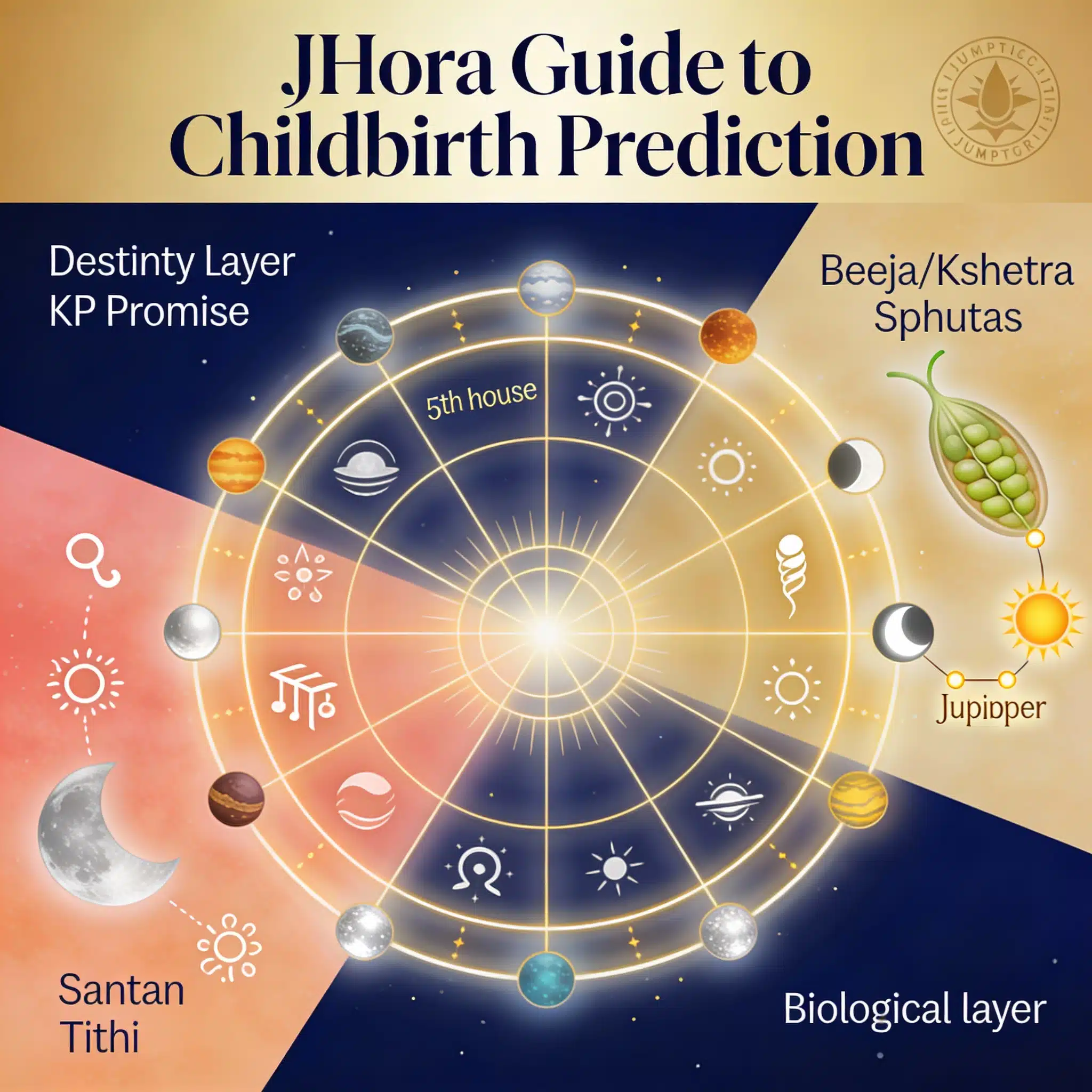
This comprehensive guide introduces the Hybrid Diagnosis Framework—a methodological approach using Jagannatha Hora software that synthesizes three analytical layers to produce predictions that are both accurate and medically relevant.
Table of Contents
The Three-Layer Framework Overview
Layer 1 — The Destiny Layer (KP System): We employ the Krishnamurti Paddhati’s 5th Cusp Sub-Lord analysis to determine whether the universe has written progeny into your life narrative. This answers the binary question: Is a child destined or denied?
Layer 2 — The Biological Layer (Beeja & Kshetra Sphutas): Ancient Jyotish recognized that destiny and biology are separate matters. A man might be destined for children yet possess weak seed; a woman might have perfect fertility but face karmic obstacles. The Beeja Sphuta (Seed Point) and Kshetra Sphuta (Field Point) provide biological assessment—crucial in an era of assisted reproductive technologies.
Layer 3 — The Karmic Layer (Santan Tithi): Even when destiny permits and biology cooperates, karmic debts can create inexplicable blockages. The Santan Tithi calculation reveals these hidden obstacles, often explaining why couples with every apparent advantage struggle with conception.
The 2026 Jupiter Transit: A Critical Timing Window
Before diving into technical methodology, note an important celestial development. Jupiter’s transit through Taurus (May 2024 – May 2025) and subsequently into Gemini (May 2025 – May 2026) creates particularly potent windows for childbirth-related events. Jupiter transiting over natal Moon or 5th house cusp points can trigger pregnancy in charts where the promise exists.
For clients consulting you in 2025-2026, always cross-reference their natal placements with these transit positions—what appears as a delayed promise may simply be awaiting Jupiter’s activation.
Part 1: The KP “Promise” — The Destiny Layer
The Krishnamurti Paddhati revolutionized predictive astrology by introducing the concept of the Sub-Lord—the planet ruling the sub-division within a star where a cusp falls. For childbirth prediction, the 5th Cusp Sub-Lord (5CSL) becomes the single most critical factor. It determines not merely the timing of events, but whether the event can occur at all.
Want this read in your own chart?
Reading your own chart is good for learning and unreliable for deciding. Not because the technique is difficult, but because nobody has distance from a question about their own children. Hope and worry distort the same placement, usually in opposite directions on different days.
This page gives you the general reading for that placement. What it cannot do is weigh it against the rest of your chart, or tell you which version of it is yours.
Send me your birth details and your questions on WhatsApp. I can usually take the call the same day, and if there is no slot free we will arrange a time that suits you. It runs 30 to 40 minutes by voice, in English, Hindi or Punjabi, and you can follow up by message afterwards.
Message on WhatsAppPersonal reading with Parminder Chahal · ₹2,100
Payment using UPI , international clients through service like Remitly.
The Fundamental KP Rule for Progeny
Prof. K.S. Krishnamurti established a clear principle: For childbirth to be promised in a horoscope, the 5th Cusp Sub-Lord must signify at least one of the houses 2, 5, or 11. These houses form the “Fruitful Group” for progeny matters:
- 2nd House: The house of family expansion. It governs the growth of one’s domestic unit. A child is fundamentally an addition to the family structure, making the 2nd house’s signification essential.
- 5th House: The primary house of progeny, creativity, and what we produce from ourselves. This is the direct significator of children—their conception, birth, and the joy they bring.
- 11th House: The house of fulfillment of desires and gains. A child represents the ultimate gain from the 5th house matters. The 11th being 7th from 5th also indicates the manifestation of 5th house potential into tangible reality.
Understanding Signification Chains
In KP, a planet signifies houses through a specific hierarchy. When analyzing the 5th Cusp Sub-Lord, trace its complete signification chain:
- Occupancy: Which house does the 5CSL physically occupy in the chart?
- Ownership: Which houses does the 5CSL rule (considering only Mooltrikona signs for dual ownership planets)?
- Star Lord’s Position: In which house does the star lord of the 5CSL sit? The planet strongly takes on these significations.
- Star Lord’s Ownership: Which houses does the star lord own?
A positive promise requires at least one connection to houses 2, 5, or 11 through any of these levels. The strength of the promise increases with multiple connections.
Special Case: When Rahu or Ketu is Your 5CSL
In KP Astrology, Rahu and Ketu hold exceptional importance—they are often considered the strongest planets in terms of delivering results. However, they function differently from the seven visible planets.
🔑 Key Rule: Rahu and Ketu do not own any signs—they act as agents. If your 5CSL is Rahu or Ketu, you must analyze:
- The sign lord: Which planet rules the sign where Rahu/Ketu is placed? That planet’s significations are absorbed by Rahu/Ketu.
- Conjunct planets: Any planet within close conjunction (typically within 5°) transfers its significations to Rahu/Ketu.
- Aspecting planets: Planets casting strong aspects on Rahu/Ketu also influence their agency.
Example: If Rahu is your 5CSL and sits in Taurus conjunct Venus, Rahu primarily acts as an agent for Venus. You would then analyze Venus’s significations. If Venus signifies houses 2, 5, or 11, the promise for progeny exists through Rahu’s agency.
This “agent theory” is one of the most critical concepts in KP—overlooking it when Rahu or Ketu appears as a sub-lord is a common error that leads to failed predictions.
The Negation Principle: Houses That Deny Progeny
Equally important is understanding which houses, when signified exclusively by the 5CSL, indicate denial of progeny:
- 1st House: Represents the self in isolation. Heavy 1st house signification without 2, 5, or 11 indicates self-focused life patterns that don’t extend to progeny.
- 4th House: Being 12th from the 5th, it represents loss or dissolution of 5th house matters. Strong 4th house signification can indicate circumstances that prevent or end pregnancy.
- 10th House: Being 6th from the 5th, it indicates obstacles, delays, and difficulties regarding progeny. Career-focused life at the expense of family is a common manifestation.
Critical Interpretation Note: The word “exclusively” is paramount here. If the 5CSL signifies both the 10th house AND the 5th house, the promise exists—it merely suggests the native may have children later in life, possibly after establishing their career. Denial only occurs when houses 1, 4, or 10 dominate WITHOUT any connection to the fruitful houses.
The Retrograde Factor: A Hidden Delay Mechanism
Even when the 5CSL signifies fruitful houses, one additional factor can withhold or significantly delay the promise: retrograde motion of the Star Lord.
⚠️ Important Warning: If the Star Lord of your 5th Cusp Sub-Lord is retrograde in the natal chart, the promise of progeny is often:
- Withheld until a later Dasha period
- Delayed until the retrograde planet turns direct in transit
- Fulfilled only after the native undergoes significant life changes
How to check in JHora: Look at the Planetary Longitudes table. Retrograde planets are marked with an “R” or “(R)” next to their position. If the Star Lord of your 5CSL shows this marking, factor in potential delays when timing predictions.
This doesn’t negate the promise—it modifies the timeline. Many practitioners have observed that retrograde Star Lords deliver results during their direct motion periods in transit, or when the native enters a Dasha ruled by a direct planet that also signifies the fruitful houses.
JHora Implementation: Finding the 5th Cusp Sub-Lord
Jagannatha Hora provides all necessary tools for KP analysis, but the correct settings must be established first.
Step 1: Configure the Ayanamsa
Before any KP work, ensure the software uses the correct ayanamsa. KP practitioners predominantly use either “KP Original” or “KP New” (refined modern calculation). Most contemporary KP astrologers prefer KP New.
Navigation Path: Preferences → Related to Calculations → Ayanamsa
- Open JHora and load the chart you wish to analyze
- Navigate to the Preferences menu at the top of the screen
- Select Related to Calculations
- Click on Ayanamsa
- From the dropdown list, select “KP New” (or “KP Original” based on your preference)
- Click OK to apply the changes
- Important: Go to File → Save Preferences to make this setting permanent
⚠️ Warning: If you skip this step and use Lahiri or any other ayanamsa, your sub-lord calculations will be incorrect. The difference between ayanamsas can shift cusps by a few degrees—enough to change the sub-lord entirely. Always verify your ayanamsa setting before KP analysis.
💡 Pro Tip: JHora can reset to default settings after updates or if preferences aren’t saved properly. If you also use Parashari astrology with Lahiri ayanamsa, consider creating two separate JHora shortcuts with different configuration files—one for KP work and one for traditional analysis. Alternatively, always double-check your Ayanamsa setting at the start of every KP session.
Step 2: Access the Cusps Table
Navigation Path: Chakras Tab → Cusps
- Look at the main chart window and locate the Chakras tab
- Click on Chakras to expand the options
- Select Cusps from the available choices
- A table will appear displaying all twelve house cusps with their associated Star Lord and Sub-Lord
Step 3: Identify the 5th Cusp Sub-Lord
In the Cusps table, locate Row 5 (representing the 5th house cusp). The table displays several columns:
- Cusp: The exact longitude of the house cusp
- Sign: The zodiac sign where the cusp falls
- Star: The nakshatra lord (star lord) of that position
- Sub: The sub-lord—THIS IS YOUR 5CSL
Note down the planet appearing in the Sub column for Row 5. This planet’s significations will determine whether childbirth is promised.
Step 4: Analyze the Sub-Lord’s Significations
Once you have identified the 5CSL, trace its complete signification chain using the KP Significators table:
Navigation Path: Tables Tab → KP Significators
This table lists each planet with its complete signification chain—occupancy, ownership, and star lord significations.
Part 2: The Biological Capacity — Beeja & Kshetra Sphutas
Even when the KP promise clearly indicates progeny, conception may fail due to biological factors. The sages developed specialized calculations—the Beeja Sphuta (Seed Point) for men and Kshetra Sphuta (Field Point) for women—to assess reproductive capacity independent of destiny indicators.
Beeja Sphuta: The Seed Longitude (For Male Charts)
The Beeja Sphuta calculates a sensitive point reflecting male reproductive vitality:
Beeja Sphuta = Sun + Venus + Jupiter
Each component contributes specific qualities to male fertility:
- Sun: Represents vital force, constitution, and core life energy. A strong Sun indicates robust overall health necessary for reproductive function.
- Venus: Governs reproductive fluids, sexual vitality, and physical aspects of procreation. Venus’s condition directly impacts sperm quality and quantity.
- Jupiter: The karaka (significator) for children in all charts. Jupiter’s inclusion ensures progeny potential is woven into the calculation.
Evaluating Beeja Sphuta Strength
Key Rule: For strong male fertility, the Beeja Sphuta must fall in an ODD Sign AND an ODD Navamsa.
Odd Signs: Aries (1), Gemini (3), Leo (5), Libra (7), Sagittarius (9), Aquarius (11)
If the Beeja Sphuta falls in an even sign or even navamsa, it indicates potential weakness in male reproductive capacity. This doesn’t mean sterility—it suggests conception may require more effort, optimal timing, or potentially medical assistance.
Kshetra Sphuta: The Field Longitude (For Female Charts)
The Kshetra Sphuta (“Field” referring to the womb) assesses female reproductive capacity:
Kshetra Sphuta = Moon + Mars + Jupiter
The planetary components reflect female reproductive physiology:
- Moon: Governs menstrual cycles, hormonal balance, and nurturing capacity. The Moon’s condition directly impacts ovulation regularity and uterine health.
- Mars: Represents blood, vitality, and muscular aspects of reproduction. Mars influences uterine strength and the body’s ability to sustain pregnancy.
- Jupiter: Again appears as the universal karaka for children, ensuring fertility calculation includes progeny potential.
Evaluating Kshetra Sphuta Strength
The evaluation rule for Kshetra Sphuta is the exact opposite of Beeja Sphuta:
Key Rule: For strong female fertility, the Kshetra Sphuta must fall in an EVEN Sign AND an EVEN Navamsa.
Even Signs: Taurus (2), Cancer (4), Virgo (6), Scorpio (8), Capricorn (10), Pisces (12)
This polarity reflects the cosmic principle of masculine (odd) and feminine (even) energies.
Odd vs Even Signs Quick Reference Table
| Sign Number | Sign Name | Category | Beeja Sphuta (Male) | Kshetra Sphuta (Female) |
|---|---|---|---|---|
| 1 | Aries | Odd | ✓ Favorable | Unfavorable |
| 2 | Taurus | Even | Unfavorable | ✓ Favorable |
| 3 | Gemini | Odd | ✓ Favorable | Unfavorable |
| 4 | Cancer | Even | Unfavorable | ✓ Favorable |
| 5 | Leo | Odd | ✓ Favorable | Unfavorable |
| 6 | Virgo | Even | Unfavorable | ✓ Favorable |
| 7 | Libra | Odd | ✓ Favorable | Unfavorable |
| 8 | Scorpio | Even | Unfavorable | ✓ Favorable |
| 9 | Sagittarius | Odd | ✓ Favorable | Unfavorable |
| 10 | Capricorn | Even | Unfavorable | ✓ Favorable |
| 11 | Aquarius | Odd | ✓ Favorable | Unfavorable |
| 12 | Pisces | Even | Unfavorable | ✓ Favorable |
JHora Implementation: Displaying Beeja and Kshetra Sphutas
Jagannatha Hora includes these calculations but hides them by default. Here’s how to enable their display:
Navigation Path: Right-click "Planetary Longitudes" window → Choose a view → Optional bodies → Check "Kshetra sphuta and beeja sphuta"
Step-by-Step Instructions
- Open the chart in JHora and ensure the Planetary Longitudes window is visible
- Right-click anywhere within the Planetary Longitudes window
- From the context menu, select “Choose a view”
- In the submenu, click on “Optional bodies”
- Locate and check the box next to “Kshetra sphuta and beeja sphuta”
- Click OK or close the menu
- The Planetary Longitudes table will now include rows for both Beeja Sphuta and Kshetra Sphuta
To check the Navamsa position, look at the Navamsa chart (D-9) and note which sign the sphuta falls in.
Part 3: The Karmic Obstacle — Santan Tithi
The third layer addresses the most mysterious dimension of childbirth prediction: karmic blockages. There are charts where the KP promise is clear, the Sphutas are strong, yet pregnancy doesn’t occur. Medical tests reveal no abnormalities. The couple tries for years without success. Then, seemingly inexplicably, conception happens—often after performing specific remedies or during particular spiritual phases.
The Santan Tithi calculation helps identify these hidden karmic factors.
KP Childbirth Calculator
Enter values between 0 and 360.
♋ Cancer (+90) | ♌ Leo (+120) | ♍ Virgo (+150)
♎ Libra (+180) | ♏ Scorpio (+210) | ♐ Sag (+240)
♑ Cap (+270) | ♒ Aqua (+300) | ♓ Pisces (+330)
Ex: 10° Taurus = 30 + 10 = 40
The Santan Tithi Calculation
The formula derives from the basic tithi calculation, multiplied by a factor of 5:
Santan Tithi = (Moon Longitude – Sun Longitude) × 5
Calculation Steps
Step 1: Obtain the exact longitude of Moon and Sun from the birth chart. Convert to absolute degrees (0-360° starting from 0° Aries). For example, Moon at 15° Taurus = 45° (30° for Aries + 15°); Sun at 20° Aries = 20°.
Step 2: Subtract Sun longitude from Moon longitude. If the result is negative, add 360°.
Step 3: Multiply the result by 5.
Step 4: If the result exceeds 360°, keep subtracting 360° until you get a value between 0° and 360°.
Step 5: Divide the final result by 12 to determine which Tithi it corresponds to. The quotient (ignoring remainder) plus 1 gives the Tithi number (1-30).
Worked Example: Calculating Santan Tithi
Given: Moon at 25° Gemini, Sun at 10° Aries Step 1 — Convert to absolute degrees:
- Moon: Gemini starts at 60° (Aries 0° + Taurus 30° + Gemini). So 25° Gemini = 60 + 25 = 85°
- Sun: Aries starts at 0°. So 10° Aries = 10°
Step 2 — Subtract: 85° – 10° = 75°Step 3 — Multiply by 5: 75 × 5 = 375°Step 4 — Normalize: 375° exceeds 360°, so: 375 – 360 = 15°Step 5 — Find Tithi: 15 ÷ 12 = 1.25 → Take whole number 1, add 1 = 2nd Tithi (Dwitiya)Result: Santan Tithi is Dwitiya (2nd) — this is NOT a Chhidra Tithi, so no karmic blockage from this factor.
Another Quick Example: If your final result is 42°, then 42 ÷ 12 = 3.5. Take the whole number (3), add 1 = 4th Tithi (Chaturthi) — this IS a Chhidra Tithi indicating obstacles.
The Problematic Tithis
Not all tithis are equal for progeny matters. Certain tithis indicate karmic obstacles:
Amavasya (New Moon Tithi – 30/Pratipada)
If the Santan Tithi calculation yields Amavasya, it indicates a profound karmic blockage. Amavasya represents the complete absence of lunar light—symbolically, a lack of nurturing energy for progeny matters. This doesn’t indicate permanent denial but suggests significant spiritual work or patience is required.
Chhidra Tithis (The “Pierced” Lunar Days)
The Chhidra Tithis are considered inauspicious for progeny: 4th (Chaturthi), 6th (Shashthi), 8th (Ashtami), 9th (Navami), 12th (Dwadashi), and 14th (Chaturdashi).
Chhidra Tithis: Karmic Implications & Remedial Focus
| Tithi | Name | Ruling Deity | Karmic Implication | Remedial Focus |
|---|---|---|---|---|
| 4th | Chaturthi | Ganesha | Obstacles requiring patience and persistence | Ganesha worship, removal of obstacles |
| 6th | Shashthi | Kartikeya | Health impediments or conflicts affecting conception | Skanda Shashthi vrat, health focus |
| 8th | Ashtami | Rudra/Bhairava | Transformation required before conception | Shiva worship, life changes needed |
| 9th | Navami | Durga/Ambika | Ancestral karma affecting progeny matters | Pitru tarpan, ancestral remedies |
| 12th | Dwadashi | Vishnu | Financial stabilization needed; costly treatments likely | Vishnu worship, financial planning |
| 14th | Chaturdashi | Shiva (destructive) | Deep karmic debts requiring spiritual intervention | Maha Mrityunjaya japa, intensive sadhana |
| 30th | Amavasya | Pitrus | Profound ancestral blockage; absent nurturing energy | Intensive Pitru remedies, patience |
Important Clarification: A problematic Santan Tithi does not indicate permanent childlessness. It indicates that the path to parenthood may be more challenging, may require remedies, or may manifest through unconventional means (adoption, surrogacy, later-life conception).
JHora Note on Santan Tithi
Currently, Jagannatha Hora does not automatically calculate the Santan Tithi. You must perform this calculation manually using the planetary longitudes displayed in the software. JHora does display the birth Tithi, which you can use as a starting reference.
Part 4: The Diagnostic Integration Table
Now we integrate all three layers into a comprehensive diagnostic table for quick assessment:
| KP Promise (5CSL) | Sphuta Strength | Santan Tithi | Prediction & Guidance |
|---|---|---|---|
| Strong (2, 5, 11) | Strong | Favorable | Natural conception likely. Time as per Dasha. |
| Strong (2, 5, 11) | Weak | Favorable | Child via IVF/medical assistance likely. |
| Strong (2, 5, 11) | Strong | Problematic | Delayed conception. Remedies accelerate results. |
| Strong (2, 5, 11) | Weak | Problematic | Child through adoption/surrogacy most likely. |
| Weak/Denied (1, 4, 10) | Strong | Favorable | Possible late-life conception. Check spouse chart. |
| Weak/Denied (1, 4, 10) | Weak | Any | Biological children unlikely. Focus on spiritual pursuits. |
| Mixed (2/5/11 with 4/10) | Strong | Favorable | Child after career establishment/relocation. |
| Mixed significations | Mixed | Problematic | Complex case. Analyze both spouse charts together. |
This table provides initial guidance, but remember that astrology is an art as much as a science. Consider additional factors: Jupiter’s overall strength, the 5th lord’s condition, aspects to the 5th house, and crucially, the Dasha periods that activate or suppress these significations.
Conclusion: Integrating the Three Layers
The Hybrid Diagnosis Framework transforms childbirth prediction from guesswork into systematic analysis. By examining destiny (KP), biology (Sphutas), and karma (Santan Tithi) separately before integrating them, you can provide clients with answers that are both accurate and actionable.
When a client asks, “Will I have children?”—you’re no longer limited to vague responses about Jupiter’s aspects. Instead, you can say: “Your 5th Cusp Sub-Lord signifies houses 5 and 11, indicating clear promise. Your Beeja Sphuta falls in an odd sign and odd navamsa, suggesting good biological capacity. However, your Santan Tithi corresponds to the 8th lunar day, indicating some karmic transformation is required before conception. I recommend Jupiter-related remedies, and the upcoming Jupiter transit over your 5th house cusp in 2026 could be the triggering period.”
This level of precision builds trust with clients and helps them understand their situation beyond simple yes-or-no answers. For couples struggling with fertility, knowing whether the issue is biological (suggesting medical intervention), karmic (suggesting remedial measures), or destinal (suggesting acceptance or alternative paths) can be life-changing information.
As you practice with this framework, you’ll develop intuition for how these layers interact. Always remember the fundamental hierarchy: KP promise determines whether; Sphutas determine how; Santan Tithi reveals what obstacles must be overcome.
Quick Reference: JHora Click Paths
| Task | Navigation Path |
|---|---|
| Set KP Ayanamsa | Preferences → Related to Calculations → Ayanamsa → KP New |
| Find 5th Cusp Sub-Lord | Chakras Tab → Cusps → Row 5 → "Sub" column |
| View KP Significators | Tables Tab → KP Significators |
| Display Beeja/Kshetra Sphutas | Right-click Planetary Longitudes → Choose a view → Optional bodies → Check "Kshetra sphuta and beeja sphuta" |
Frequently Asked Questions
What is the 5th Cusp Sub-Lord in KP Astrology?
The 5th Cusp Sub-Lord (5CSL) is the planet that rules the sub-division of the nakshatra where the 5th house cusp falls. In KP astrology, this planet is the primary determinant for childbirth promise. To find it in JHora, navigate to Chakras Tab → Cusps and look at the “Sub” column for Row 5. The 5CSL’s signification of houses 2, 5, or 11 indicates progeny is promised, while exclusive signification of houses 1, 4, or 10 suggests denial.
What if Rahu or Ketu is my 5th Cusp Sub-Lord?
When Rahu or Ketu is your 5CSL, you must apply the “agent theory” since these shadow planets don’t own any signs. Analyze three factors: (1) the lord of the sign where Rahu/Ketu sits—this planet’s significations transfer to Rahu/Ketu, (2) any planet closely conjunct Rahu/Ketu within 5°, and (3) planets strongly aspecting Rahu/Ketu. For example, if Rahu is your 5CSL and sits in Taurus with Venus, analyze Venus’s house significations to determine the promise. This is one of the most critical rules in KP astrology.
Does retrograde motion affect childbirth prediction in KP?
Yes, retrograde motion of the Star Lord significantly impacts timing. If the Star Lord of your 5th Cusp Sub-Lord is retrograde in the natal chart, the promise of progeny is often withheld or delayed—sometimes until the planet turns direct in transit, or until the native enters a Dasha period ruled by a direct planet signifying fruitful houses. In JHora, check the Planetary Longitudes table for an “R” marking next to planets. Retrograde doesn’t negate the promise but modifies the timeline considerably.
How do I calculate Beeja Sphuta and Kshetra Sphuta in JHora?
JHora calculates these automatically but hides them by default. To display them: Right-click on the “Planetary Longitudes” window → Select “Choose a view” → Click “Optional bodies” → Check the box next to “Kshetra sphuta and beeja sphuta” → Click OK. The sphutas will now appear in your planetary positions table with their exact zodiacal longitudes.
What is the formula for Beeja Sphuta?
Beeja Sphuta (used for male fertility assessment) is calculated as: Sun longitude + Venus longitude + Jupiter longitude. If the total exceeds 360°, subtract 360° to get the final position. For strong male fertility, the Beeja Sphuta should fall in an odd sign (Aries, Gemini, Leo, Libra, Sagittarius, or Aquarius) and an odd navamsa division.
What is the formula for Kshetra Sphuta?
Kshetra Sphuta (used for female fertility assessment) is calculated as: Moon longitude + Mars longitude + Jupiter longitude. If the total exceeds 360°, subtract 360° to get the final position. For strong female fertility, the Kshetra Sphuta should fall in an even sign (Taurus, Cancer, Virgo, Scorpio, Capricorn, or Pisces) and an even navamsa division.
What is Santan Tithi and how do I calculate it?
Santan Tithi is a specialized calculation for assessing karmic factors affecting childbirth. The formula is: (Moon Longitude – Sun Longitude) × 5. First convert both positions to absolute degrees (0-360° from Aries). If the Moon-Sun difference is negative, add 360°. Multiply by 5. If the result exceeds 360°, subtract 360° repeatedly until you get 0-360°. Finally, divide by 12 (each tithi = 12°), take the whole number, and add 1. Example: Result of 42° gives 42÷12=3.5, take 3, add 1 = 4th Tithi (Chaturthi). JHora doesn’t calculate this automatically.
Which Santan Tithis indicate problems with childbirth?
The problematic Santan Tithis are Amavasya (30th/New Moon) and the Chhidra Tithis: Chaturthi (4th), Shashthi (6th), Ashtami (8th), Navami (9th), Dwadashi (12th), and Chaturdashi (14th). These indicate karmic blockages that may delay conception or require specific remedies. However, they don’t indicate permanent denial—rather, they suggest the path to parenthood may require additional effort or spiritual intervention.
Can a person have children if the 5CSL signifies houses 1, 4, or 10?
Denial only occurs when the 5CSL signifies houses 1, 4, or 10 exclusively without any connection to the fruitful houses (2, 5, 11). If the 5CSL signifies both problematic and fruitful houses (for example, 5th and 10th), progeny is still promised but may come after delays—often after career establishment or significant life changes. Always trace the complete signification chain through occupancy, ownership, and star lord connections.
What does weak Beeja Sphuta mean for male fertility?
A weak Beeja Sphuta (falling in an even sign or even navamsa) indicates potential biological challenges with male reproductive capacity. This doesn’t mean sterility—it suggests conception may require optimal timing, lifestyle modifications, or medical assistance such as IUI or IVF. When combined with a strong KP promise, the indication is that children will come but likely through assisted reproductive technologies.
How does Jupiter transit affect childbirth timing in 2026?
Jupiter’s transit through Gemini (May 2025 – May 2026) creates significant triggering potential for childbirth events. When transit Jupiter crosses over the natal Moon, 5th house cusp, or the position of the 5th Cusp Sub-Lord, it can activate latent promises in the horoscope. For couples with positive indicators who haven’t yet conceived, this transit period deserves special attention for timing predictions using Vimshottari Dasha confirmations.
Should I analyze both spouse charts for childbirth prediction?
Yes, comprehensive childbirth prediction requires analyzing both partners’ charts. The KP promise should ideally be present in both charts, or at minimum, the spouse’s chart should not strongly deny progeny. Beeja Sphuta is assessed from the husband’s chart while Kshetra Sphuta is assessed from the wife’s chart. When one chart shows weakness and the other shows strength, the outcome often manifests through medical assistance or requires favorable Dasha timing in both charts simultaneously.
What ayanamsa should I use for KP childbirth prediction in JHora?
For KP astrology, you must use either “KP Original” or “KP New” ayanamsa—never Lahiri or other systems. Most contemporary KP practitioners prefer “KP New” for its refined calculations. In JHora, set this via: Preferences → Related to Calculations → Ayanamsa → Select “KP New”. Using the wrong ayanamsa can shift cusp positions by several degrees, completely changing the sub-lord and invalidating your analysis.
Want this read in your own chart?
Reading your own chart is good for learning and unreliable for deciding. Not because the technique is difficult, but because nobody has distance from a question about their own children. Hope and worry distort the same placement, usually in opposite directions on different days.
Send me your birth details and your questions on WhatsApp. I can usually take the call the same day, and if there is no slot free we will arrange a time that suits you. It runs 30 to 40 minutes by voice, in English, Hindi or Punjabi, and you can follow up by message afterwards.
Message on WhatsAppPersonal reading with Parminder Chahal · ₹2,100
Payment using UPI , international clients through service like Remitly.