Complete Hindu Vivah Muhurat Calendar with Astrology Guidance
Planning for 2027? Jump to 2027 marriage dates ↓
Coverage: 2026–2027 · Updated annually using Panchang references
Last updated: January 2026
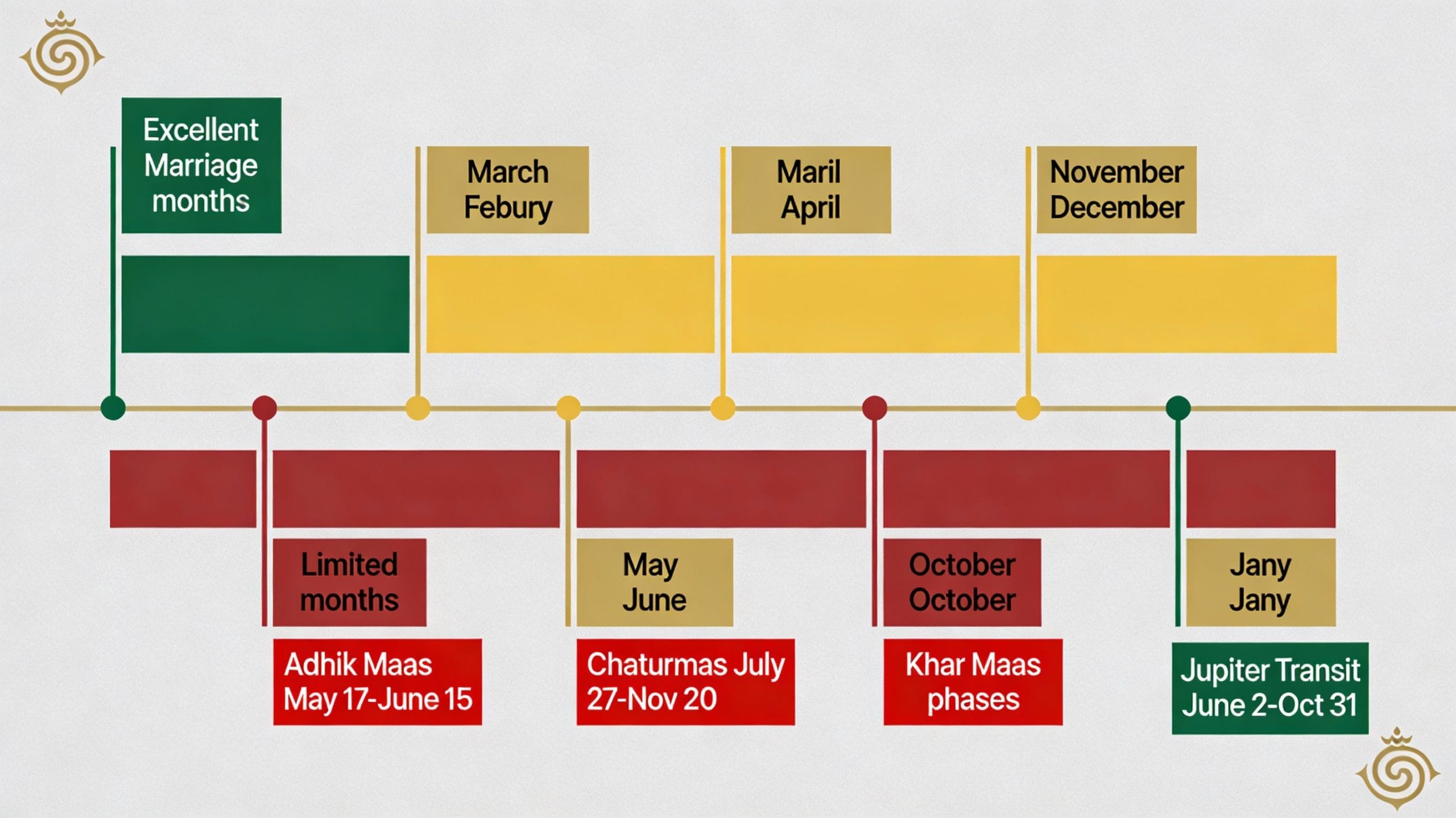
Planning a wedding in 2026? This year presents unique challenges and opportunities for couples seeking auspicious marriage dates. With Adhik Maas (the leap month) blocking peak wedding season from May 17 to June 15, and Chaturmas creating a four-month pause from late July through November, understanding the Hindu Panchang becomes essential for selecting truly auspicious wedding dates.
This comprehensive guide provides month-by-month marriage muhurat dates for 2026, explains the astronomical and spiritual factors that make certain dates auspicious, and helps you navigate the complex interplay of Tithi, Nakshatra, and planetary positions that determine wedding timing in Vedic astrology.
📅 2026 Wedding Availability at a Glance
| Month | Status | Key Notes |
|---|---|---|
| January | BLOCKED | Dhanu Khar Maas + Venus Combustion |
| February | EXCELLENT | 12 dates available; Vasant Panchami Feb 12 |
| March | PARTIAL | Good dates before March 14; Meen Khar Maas after |
| April | EXCELLENT | Akshaya Tritiya April 19 – Swayam Siddha Muhurat |
| May | COMPLICATED | Available May 1-16; BLOCKED May 17+ (Adhik Maas) |
| June | PARTIAL | BLOCKED June 1-15; Available June 16-30 |
| July | LIMITED | Available July 1-24; Chaturmas begins July 25 |
| Aug-Oct | BLOCKED | Complete Chaturmas blockade |
| November | RESUMES | Dev Uthani Ekadashi Nov 20 – Wedding season restarts |
| December | PARTIAL | Good Dec 1-15; BLOCKED Dec 16+ (Dhanu Khar Maas) |
Total estimated auspicious marriage dates in 2026: 35-50 dates (depending on regional Panchang)
- Marriage Dates in February 2026
- Marriage Dates in March 2026
- Marriage Dates in April 2026
- Marriage Dates in May 2026 (Adhik Maas)
- Marriage Dates in June 2026
- Marriage Dates in July 2026
- August–October 2026 (Chaturmas Block)
- Marriage Dates in November 2026
- Marriage Dates in December 2026
- Adhik Maas 2026 Explained
- Chaturmas 2026 Explained
- Guna Milan & Compatibility
- Frequently Asked Questions
📿 What Makes a Marriage Date Auspicious in Hindu Astrology?
In Vedic tradition, marriage (Vivah) is considered one of the most sacred Samskaras (sacraments) of life. The selection of an auspicious date and time—called Vivah Muhurat—is not merely a matter of convenience but a deliberate alignment with cosmic energies that are believed to influence the couple’s married life for decades to come.
The Hindu Panchang (almanac) provides a sophisticated framework for determining auspiciousness through the analysis of multiple celestial factors. Unlike the Western calendar which simply counts days, the Panchang tracks the intricate dance of the Sun, Moon, and other celestial bodies to identify windows of harmony and blessing. For those new to these concepts, understanding the core principles of Vedic astrology helps make sense of how these elements work together.
🌙 The 6 Limbs of Panchang: Tithi, Nakshatra, Yoga, Karana, Vara & Lagna
The Panchang consists of five primary elements (Pancha means five, Anga means limbs), plus the crucial sixth element of Lagna (ascendant) that determines the precise timing of the wedding ceremony:
1. Tithi (Lunar Day) — Primary Factor
Tithi represents the angular relationship between the Sun and Moon, creating 30 lunar days in each month. For marriage, certain Tithis are considered highly auspicious while others are strictly forbidden:
✓ Auspicious Tithis: Dwitiya (2nd), Tritiya (3rd), Panchami (5th), Saptami (7th), Ekadashi (11th), Trayodashi (13th)
✗ Forbidden Tithis (Rikta): Chaturthi (4th), Navami (9th), Chaturdashi (14th)
✗ Generally Avoided: Amavasya (New Moon) and Purnima (Full Moon)
2. Nakshatra (Birth Star) — Secondary Factor
The Moon’s position among the 27 Nakshatras (lunar mansions) significantly influences the energy of any given day. Of the 27 Nakshatras, 15 are considered suitable for marriage:
Most Auspicious: Rohini, Mrigashira, Magha, Uttara Phalguni, Hasta, Swati, Anuradha
Good: Chitra, Uttara Ashadha, Uttara Bhadrapada, Revati, Mula, Pushya
Conditional: Ashwini, Moola (with specific precautions)
3. Yoga (Planetary Alignment) — Tertiary Factor
Yoga refers to specific combinations of the Sun and Moon that create 27 different energy patterns:
✓ Auspicious Yogas: Siddha, Shiva, Siddhi, Shubha, Brahma, Indra, Priti
✗ Inauspicious Yogas: Vishkambha, Atiganda, Shula, Ganda, Vyaghata — bring obstacles, disease, or conflict
4. Karana (Half-Tithi) — Supporting Factor
Each Tithi is divided into two Karanas, creating 11 types that repeat throughout the month:
✓ Auspicious: Kinstughna, Bava, Balava, Kaulava, Taitila, Garaja, Vanija
✗ Inauspicious: Vishti (Bhadra), Shakuni, Chatushpada, Nagava
5. Vara (Weekday) — Supporting Factor
The day of the week carries its own planetary energy:
✓ Most Auspicious: Monday (Moon), Wednesday (Mercury), Thursday (Jupiter), Friday (Venus)
✗ Generally Avoided: Tuesday (Mars) — associated with aggression and conflict
Conditional: Sunday (Sun), Saturday (Saturn) — may be used with other strong factors
6. Lagna (Ascendant) — Timing Factor
The rising sign at the moment of marriage determines the exact time window for the ceremony:
✓ Most Auspicious Lagnas: Mithuna (Gemini), Kanya (Virgo), Tula (Libra)
✓ Good Lagnas: Vrishabha (Taurus), Dhanu (Sagittarius), Meena (Pisces)
✗ Generally Avoided: Mesh (Aries), Simha (Leo), Vrishchika (Scorpio)
⚖️ Why Tithi Dominates: The Hierarchy of Panchang Elements
Not all Panchang elements carry equal weight. Classical texts like Muhurta Chintamani establish a clear hierarchy:
- Tithi (Primary): Governs the fundamental energy of the day
- Nakshatra (Secondary): Refines the quality and nature of that energy
- Yoga (Tertiary): Acts as a multiplier, enhancing or diminishing other factors
- Karana & Vara (Supporting): Provide additional context but rarely override stronger factors
- Lagna (Timing): Determines the precise window within an auspicious day
This hierarchy explains why a day with an excellent Tithi but moderate Nakshatra may be preferred over a day with excellent Nakshatra but problematic Tithi. The Tithi sets the foundation; other elements build upon it.
☀️ Solar Rashi Transits vs. Lunar Panchang: Which Takes Priority?
The Hindu calendar operates on both solar and lunar cycles, and understanding their interaction is crucial:
Solar Calendar Considerations
Auspicious Rashis (Sun’s position): Mesha (Aries), Vrishabha (Taurus), Mithuna (Gemini), Karka (Cancer), Simha (Leo), Kanya (Virgo), Tula (Libra)
Forbidden: Dhanu (Sagittarius) during Khar Maas, Meena (Pisces) during Khar Maas
Rule: Solar Rashi takes precedence for determining whether marriages are permitted at all (macro-level), while lunar Panchang determines the specific auspicious dates within permitted periods (micro-level).
🚫 Common Myths About “Lucky” Wedding Dates
Myth 1: “If the date is Shubh, any two people can marry on it.”
FALSE. A shubh (auspicious) date provides favorable cosmic conditions, but Guna Milan (horoscope matching) between the bride and groom remains essential. A minimum score of 18 out of 36 Gunas is traditionally required for marriage compatibility. The date and the couple’s compatibility are separate requirements that must both be satisfied.
Myth 2: “Khar Maas completely blocks all marriages.”
PARTIALLY FALSE. While Khar Maas is generally inauspicious for marriages, there are recognized exceptions. Vasant Panchami, for example, is considered an “Abuddha Muhurat” (self-auspicious day) that can be used even during Khar Maas for marriages.
Myth 3: “Tuesday is universally bad for weddings.”
TRUE in most Hindu traditions. Tuesday is ruled by Mars (Mangal), the planet of aggression and conflict. Most regional Panchangs explicitly exclude Tuesdays from marriage muhurat lists. However, some specific tantric traditions may differ.
Myth 4: “Manglik Dosha can be ignored if the date is very shubh.”
FALSE. Manglik Dosha (Mars affliction in the birth chart) is a personal horoscope factor that requires specific remedies regardless of muhurat quality. A shubh date cannot neutralize untreated doshas in individual charts. Both must be addressed separately.
Myth 5: “If my family astrologer rejects a popular muhurat, the date must be bad.”
SOMETIMES FALSE. Regional Panchang variations exist between North Indian (Purnimant) and South Indian (Amant) systems. A date may be auspicious in one system but not the other. Additionally, your family astrologer may be considering your personal birth charts, which could make a generally good date unsuitable for your specific situation.
📅 Month-Wise Auspicious Marriage Dates in 2026
Short Answer: Auspicious Hindu marriage dates in 2026 are mainly available in February, early March, April (including Akshaya Tritiya on April 19), early May, late June, early July, November (after Dev Uthani Ekadashi on Nov 20), and early December. Long blocked periods occur due to Adhik Maas (May 17–June 15) and Chaturmas (July 25–Nov 20).
❄️ Marriage Dates in January 2026
January 2026 presents a perfect storm of inauspicious factors that make it completely unsuitable for Hindu marriages:
- Dhanu Khar Maas: December 16, 2025 through January 14, 2026 — Sun transiting Sagittarius blocks all auspicious ceremonies
- Venus Combustion (Shukra Asta): Continuing through early February — the planet of love and marriage is overpowered by the Sun
- Sun in Capricorn: After January 14, while Khar Maas ends, Venus combustion continues
Recommendation: Avoid January entirely for wedding planning. Focus this month on venue bookings and other non-muhurat activities.
💕 Marriage Dates in February 2026
February emerges as one of the best months for weddings in 2026. With Khar Maas ending on January 14 and Venus rising from combustion around mid-February, this month offers abundant auspicious dates.
| Date | Day | Nakshatra | Status |
|---|---|---|---|
| February 5 | Thursday | Uttara Phalguni | Excellent – Jupiter’s day |
| February 6 | Friday | Hasta | Excellent – Venus’s day |
| February 8 | Sunday | Swati | Good |
| February 10 | Tuesday | Anuradha | Conditional |
| February 12 | Thursday | Mula | ★ VASANT PANCHAMI – Abuddha Muhurat |
| February 14 | Saturday | Uttara Ashadha | Good – Valentine’s Day |
| February 19 | Thursday | Uttara Bhadrapada | Excellent |
| February 20 | Friday | Revati | Excellent |
| February 21 | Saturday | Ashwini | Good |
| February 24 | Tuesday | Rohini | Conditional |
| February 25 | Wednesday | Mrigashira | Excellent |
| February 26 | Thursday | Mrigashira | Excellent |
🌸 Key Event – Vasant Panchami (February 12)
This is a Swayam Siddha Muhurat (self-auspicious day) dedicated to Goddess Saraswati. It’s considered so auspicious that no other muhurat calculation is needed. Marriages on this day are believed to bring wisdom, prosperity, and harmony.
Venus Combustion Note: While Venus combustion technically continues into early February, it ends around February 17. Dates after this point carry stronger Venus energy for marital blessings.
Recommendation: Book early! February dates fill quickly due to the month’s overall auspiciousness and pleasant weather.
🌷 Marriage Dates in March 2026
March offers a window of opportunity before Meen Khar Maas begins around March 14-17 (when the Sun enters Pisces).
| Date | Day | Nakshatra | Status |
|---|---|---|---|
| March 2 | Monday | Magha | Excellent |
| March 3 | Tuesday | Uttara Phalguni | Conditional – Tuesday |
| March 4 | Wednesday | Hasta | Excellent |
| March 7 | Saturday | Anuradha | Good |
| March 8 | Sunday | Mula | Good |
| March 9 | Monday | Uttara Ashadha | Excellent |
| March 11 | Wednesday | Shravana | Good |
| March 12 | Thursday | Dhanishtha | Good |
⚠️ Meen Khar Maas Alert
Around March 14-17, the Sun enters Pisces (Meena Rashi), initiating the second Khar Maas of the year. All auspicious ceremonies are blocked until the Sun moves into Aries around April 13-14.
Recommendation: If planning a March wedding, target the first two weeks. Avoid booking anything after March 12 unless you’ve confirmed with your regional Panchang that Khar Maas hasn’t begun.
🌺 Marriage Dates in April 2026 & Akshaya Tritiya
April is exceptional for weddings. The Sun enters Aries (exaltation sign) around April 13-14, ending Meen Khar Maas. This month also hosts one of the most powerful wedding dates of the year.
⭐ AKSHAYA TRITIYA 2026: Sunday, April 19
One of the “Sade-Teen Muhurat” — the three-and-a-half most auspicious days in the Hindu calendar where every moment is considered favorable. A Swayam Siddha Muhurat requiring no calculations.
Why Akshaya Tritiya is special:
- “Akshaya” means “never diminishing” — benefits of actions on this day are believed to multiply infinitely
- Swayam Siddha Muhurat — the entire day is auspicious without needing any other calculations
- Both Sun and Moon are in exaltation positions
- No Panchang Shuddhi required — every moment is considered muhurat
Who should target Akshaya Tritiya:
- Couples with low Guna Milan scores (18-24) seeking cosmic support
- Those with Manglik Dosha or Nadi Dosha seeking mitigation
- Intercaste or interreligion couples facing family resistance
- Anyone who missed earlier booking windows and needs a guaranteed auspicious date
📞 Booking Advisory
Akshaya Tritiya is THE most in-demand wedding date in India. Venues, caterers, photographers, and priests are typically booked 12-18 months in advance. Start your planning immediately if targeting this date.
| Date | Day | Nakshatra | Status |
|---|---|---|---|
| April 14 | Tuesday | Revati | Conditional – Mesha Sankranti |
| April 16 | Thursday | Rohini | Excellent |
| April 17 | Friday | Mrigashira | Excellent |
| April 19 | Sunday | Punarvasu | ★ AKSHAYA TRITIYA – Best date of year |
| April 23 | Thursday | Magha | Good |
| April 24 | Friday | Uttara Phalguni | Excellent |
| April 27 | Monday | Chitra | Good |
| April 30 | Thursday | Anuradha | Excellent |
🌻 Marriage Dates in May 2026 (Adhik Maas Alert)
May 2026 requires careful navigation. The month starts strong but hits a complete block when Adhik Maas (the leap month) begins on May 17.
Available Window: May 1-16
| Date | Day | Nakshatra | Status |
|---|---|---|---|
| May 1 | Friday | Mula | Excellent |
| May 3 | Sunday | Uttara Ashadha | Good |
| May 5 | Tuesday | Dhanishtha | Conditional |
| May 6 | Wednesday | Shatabhisha | Good |
| May 7 | Thursday | Uttara Bhadrapada | Excellent |
| May 8 | Friday | Revati | Excellent |
| May 13 | Wednesday | Rohini | Good |
| May 14 | Thursday | Mrigashira | Excellent – Last safe date |
🚫 ADHIK MAAS (ADHIK JYESHTHA) BEGINS: May 17, 2026
From May 17 through June 15, Adhik Maas creates a complete block on all auspicious ceremonies. This leap month, also called Purushottam Maas or Mal Maas, is dedicated to spiritual practices rather than worldly celebrations.
- No marriages, engagements, or wedding-related rituals permitted
- No Griha Pravesh, Mundan, or other major sanskaras
- This is NOT superstition — it’s a calendar alignment period for lunar-solar synchronization
Impact: Adhik Maas falls during what would typically be peak wedding season, creating significant pressure on available dates before May 17 and after June 15.
☀️ Marriage Dates in June 2026
Adhik Maas continues until June 15, 2026. Only the latter half of June offers muhurat opportunities.
BLOCKED: June 1-15 (Adhik Maas)
Available Window: June 16-30
| Date | Day | Nakshatra | Status |
|---|---|---|---|
| June 21 | Sunday | Uttara Phalguni | Good |
| June 22 | Monday | Hasta | Excellent |
| June 23 | Tuesday | Chitra | Conditional |
| June 24 | Wednesday | Swati | Good |
| June 25 | Thursday | Vishakha | Good |
| June 26 | Friday | Anuradha | Excellent |
| June 27 | Saturday | Mula | Good |
| June 29 | Monday | Uttara Ashadha | Excellent |
Recommendation: If you missed the pre-Adhik Maas window, late June offers good options. However, be aware that Chaturmas begins in late July, so there’s limited time for follow-up ceremonies.
🌧️ Marriage Dates in July 2026 (Pre-Chaturmas Rush)
July represents the last opportunity for weddings before the four-month Chaturmas block.
| Date | Day | Nakshatra | Status |
|---|---|---|---|
| July 1 | Wednesday | Shravana | Excellent |
| July 6 | Monday | Revati | Good |
| July 7 | Tuesday | Ashwini | Conditional |
| July 11 | Saturday | Mrigashira | Good |
| July 12 | Sunday | Ardra | Conditional |
🛏️ DEVSHAYANI EKADASHI: July 25, 2026
On July 25, Lord Vishnu enters Yoga Nidra (cosmic sleep), marking the beginning of Chaturmas. From this day until Dev Uthani Ekadashi in November:
- All Hindu marriages are prohibited
- Lord Vishnu is considered “asleep” and unable to bless new unions
- This is an absolute restriction with no exceptions in mainstream Hindu tradition
Recommendation: July weddings face monsoon weather challenges in most of India. If planning a July wedding, target the first week for better weather and stronger muhurat energy before Jupiter combustion begins (July 15).
🍂 Marriage Dates in August, September, October 2026
These three months offer zero marriage muhurat dates due to Chaturmas. During this period:
- Lord Vishnu remains in Yoga Nidra (cosmic sleep) in Kshirsagar
- All auspicious ceremonies are suspended
- This is the time for spiritual reflection, not worldly celebrations
- Jupiter Combustion (July 15 – August 12) overlaps with Chaturmas
- Second Venus Combustion occurs October 12-29, further reinforcing restrictions
What you CAN do during Chaturmas:
- Engagement ceremonies (in some traditions)
- Venue visits and vendor meetings
- Trousseau shopping and wedding card design
- Photography pre-shoots
Use this period for wedding preparation so you’re ready when the season resumes in November.
🪔 Marriage Dates in November 2026 & Dev Uthani Ekadashi
November marks the grand reopening of wedding season with one of the most significant dates in the Hindu calendar.
⭐ DEV UTHANI EKADASHI: Friday, November 20, 2026
The day Lord Vishnu awakens from his four-month cosmic sleep. Tulsi Vivah is performed. THE restart day for Hindu wedding season. Bookings for this date typically happen 6+ months in advance.
Why Dev Uthani Ekadashi is special:
- Marks the official end of Chaturmas
- Tulsi Vivah is performed on this day — the ceremonial marriage of Tulsi plant to Lord Vishnu
- Considered THE restart day for Hindu wedding season
- Carries “fresh start” energy and Vishnu’s awakening blessings
Who should target Dev Uthani Ekadashi:
- Couples who waited out Chaturmas for spiritual alignment
- Those seeking the “fresh start” energy of the awakening period
- Intercaste couples who benefit from the spiritually charged environment
- Anyone wanting to begin married life with Vishnu’s direct blessings upon awakening
| Date | Day | Nakshatra | Status |
|---|---|---|---|
| November 20 | Friday | Revati | ★ DEV UTHANI EKADASHI – Season restart |
| November 23 | Monday | Rohini | Excellent |
| November 25 | Wednesday | Mrigashira | Good |
| November 26 | Thursday | Ardra | Excellent – Thanksgiving (US) |
| November 27 | Friday | Punarvasu | Excellent |
| November 30 | Monday | Magha | Good |
🎄 Marriage Dates in December 2026
December offers excellent wedding opportunities in its first half before Dhanu Khar Maas begins.
| Date | Day | Nakshatra | Status |
|---|---|---|---|
| December 2 | Wednesday | Uttara Phalguni | Excellent |
| December 3 | Thursday | Hasta | Excellent |
| December 4 | Friday | Chitra | Excellent |
| December 7 | Monday | Anuradha | Good |
| December 9 | Wednesday | Mula | Good |
| December 10 | Thursday | Uttara Ashadha | Excellent |
| December 11 | Friday | Shravana | Excellent |
| December 14 | Monday | Uttara Bhadrapada | Good – Vivah Panchami |
🚫 DHANU KHAR MAAS BEGINS: December 16, 2026
From December 16, the Sun enters Sagittarius, initiating Dhanu Khar Maas that continues until January 14, 2027. All marriages are blocked during this period.
Recommendation: Early December offers the best combination of pleasant winter weather, post-Chaturmas energy, and pre-holiday timing. Book December 2-11 for optimal conditions.
🚧 Major Obstacles: Marriage Dates NOT Allowed in 2026
Understanding why certain periods are blocked helps you plan effectively and avoid costly mistakes:
- January 2026 – Dhanu Khar Maas and Venus combustion
- Mid-March to mid-April 2026 – Meen Khar Maas
- May 17 – June 15, 2026 – Adhik Maas
- July 25 – November 20, 2026 – Chaturmas
- December 16 onward – Dhanu Khar Maas
📅 Adhik Maas 2026 (Adhik Jyeshtha): The Leap Month
Adhik Maas is a leap lunar month added approximately every 32 months to synchronize the lunar calendar with the solar year. In Hindu tradition, Adhik Maas is reserved for spiritual practices, and all auspicious ceremonies such as marriage and griha pravesh are avoided during this period.
Dates: May 17 – June 15, 2026
Adhik Maas occurs approximately once every 32 months when the lunar calendar needs to synchronize with the solar calendar. In 2026, this extra month falls as Adhik Jyeshtha, directly impacting what would typically be peak wedding season.
- All auspicious ceremonies prohibited (marriages, engagements, Griha Pravesh)
- Dedicated to Lord Vishnu as Purushottam — focused on spiritual practices
- NOT considered inauspicious — spiritually powerful, but for devotion, not celebration
- Children born during Adhik Maas are considered fortunate, despite prohibition on ceremonies
Competitive Note: Many online muhurat calendars fail to account for Adhik Maas properly. This creates confusion when couples see “May dates” listed without the blocked period clarification.
🛏️ Chaturmas 2026: The Four-Month Pause
Why marriages are prohibited during Chaturmas: Chaturmas marks the period when Lord Vishnu enters Yoga Nidra (cosmic sleep). Since Vishnu is regarded as the preserver of dharma and marriage blessings, Hindu tradition suspends all auspicious ceremonies, including weddings, until Dev Uthani Ekadashi.
Dates: July 25 – November 20, 2026
Chaturmas (“four months”) is the period when Lord Vishnu sleeps in Kshirsagar on his serpent bed of Sheshnag:
- Begins on Devshayani Ekadashi (July 25, 2026)
- Ends on Dev Uthani Ekadashi (November 20, 2026)
- ABSOLUTE restriction — no exceptions for special pujas or remedies
- Coincides with monsoon season in India, reinforcing the restriction practically
This is the longest continuous blocked period in the Hindu calendar. Plan around it, not through it.
🌞 Khar Maas: Two Annual Inauspicious Phases
Khar Maas occurs twice yearly when the Sun transits Jupiter’s signs (Sagittarius and Pisces):
Dhanu Khar Maas (Sagittarius)
- 2025-26 Period: December 16, 2025 – January 14, 2026
- 2026-27 Period: December 16, 2026 – January 14, 2027
Meen Khar Maas (Pisces)
- March 14-17, 2026 – April 13-14, 2026 (exact dates vary by Panchang)
Exception: Vasant Panchami (February 12, 2026) is considered an Abuddha Muhurat that transcends Khar Maas restrictions if it falls during that period.
☀️ Tara Asta: Venus & Jupiter Combustion 2026
When benefic planets Venus (Shukra) and Jupiter (Guru) come too close to the Sun, they become “combust” — their positive energies are overwhelmed:
Venus Combustion (Shukra Asta):
- Primary Period: ~December 11, 2025 – February 1-17, 2026
- Secondary Period: October 12-29, 2026 (overlaps with Chaturmas)
Jupiter Combustion (Guru Asta):
- July 15 – August 12, 2026 (overlaps with Chaturmas, reinforcing the block)
Venus combustion is particularly significant for marriage as Venus is the Kalatra Karaka (significator of spouse). The February 2026 end of Venus combustion is why mid-to-late February becomes especially auspicious.
💑 The 8 Koots of Guna Milan: Building Compatibility Beyond Dates
What is Guna Milan?
Guna Milan (also called Kundali Milan or Horoscope Matching) is the process of assessing compatibility between prospective bride and groom by comparing their birth charts. This is separate from — and equally important as — Muhurat selection. Marriage compatibility is ultimately judged from the 7th house of each person’s chart, which governs partnership, commitment, and all spouse-related matters.
The Ashta Koota (Eight-fold) matching system assigns points across 8 categories, with a maximum score of 36:
| Score | Assessment | Recommendation |
|---|---|---|
| Below 18 | Generally rejected | Significant compatibility concerns |
| 18-24 | Average match | Marriage possible with awareness of challenges |
| 24-32 | Good match | Favorable foundation for marriage |
| 32-36 | Excellent match | Highly compatible union |
Important: A shubh muhurat cannot compensate for poor Guna Milan. Both the date and the compatibility must be favorable.
The 8 Koots Explained
| Koot | Points | What It Assesses |
|---|---|---|
| 1. Varna | 1 | Spiritual compatibility and ego harmony |
| 2. Vashya | 2 | Power dynamics and mutual influence |
| 3. Tara | 3 | Destiny compatibility based on birth stars |
| 4. Yoni | 4 | Physical and intimate compatibility |
| 5. Graha Maitri | 5 | Mental compatibility (Moon sign lords) |
| 6. Gana | 6 | Temperament (Deva, Manushya, Rakshasa) |
| 7. Bhakoot | 7 | Financial prosperity and family harmony |
| 8. Nadi | 8 | Genetic/health compatibility and progeny |
Dosha Checks That Block Marriage
Certain Guna Milan results create Doshas (afflictions) that require specific attention:
Bhakoot Dosha
Occurs when Moon signs are in 6-8 or 2-12 positions from each other. Indicates potential for financial problems and family conflicts. Remedies include specific pujas and charitable acts.
Nadi Dosha
Occurs when both partners have the same Nadi (Aadi, Madhya, or Antya). Traditionally linked to health issues and progeny concerns. Considered the most serious of the matching doshas. Requires specific remedies; some families consider it non-negotiable.
Note: Modern astrologers often apply nuanced exceptions to these Doshas based on detailed chart analysis. Blanket rejection without deeper analysis may be unnecessarily restrictive.
💕 Love Marriage, Intercaste & Interreligion Weddings in 2026
Love Marriage Yoga 2026: Planetary Alignments
“Love Marriage Yoga” refers to planetary combinations in a birth chart that indicate the native will choose their own partner rather than having an arranged marriage. In 2026, certain planetary transits support unconventional unions:
- Strong Venus: Essential for love marriages — indicates romantic nature and attraction
- 5th House Connection: The house of romance linking to the 7th house of marriage
- 7th House Activation: Direct connection between love and marriage houses
- Rahu Influence: Often present in love marriages, indicating unconventional choices
How Rahu in 7th House Enables Love Marriages
Rahu in the 7th house often appears in charts of those who marry outside conventional expectations:
- Rahu transcends social norms and conventional boundaries
- Enables intercaste, interreligion, and unconventional unions
- May bring initial turbulence or family resistance
- Often indicates foreign spouse or spouse from different background
2026 Opportunity: When Jupiter aspects Rahu or the 7th house (occurs periodically through the year), family opposition tends to soften and acceptance becomes more likely.
Navigating Intercaste & Interreligion Marriages in 2026
For couples facing family resistance due to caste, religion, or cultural differences, consider:
- Target Akshaya Tritiya (April 19): The Swayam Siddha Muhurat is believed to bless even “difficult” unions
- Jupiter Transit Windows: When Jupiter aspects your 7th house, family acceptance improves
- Dev Uthani Ekadashi (November 20): The spiritual energy of Vishnu’s awakening supports sincere unions
🔮 Suggested Remedies for Love Marriage Obstacles
- Venus Strengthening: Wear white clothes on Fridays, donate white sweets
- Shukra Shanti Puja: Pacifies Venus for marital harmony
- Ganesh Puja: Removes obstacles and smooths the path to marriage
- Navagraha Homam: Balances all planetary influences
- Swayamvara Parvati Mantra: For removing delays in marriage
⏰ Your Dasha Period: Is 2026 Your Marriage Year?
In Vedic astrology, Dasha periods (planetary time cycles) significantly influence when marriage is most likely and most auspicious. Understanding your current Dasha helps determine if 2026 is YOUR year:
Venus Mahadasha: The Gold Standard
Venus Mahadasha (20-year period) is considered the most favorable for marriage:
- Venus is the natural significator of marriage, love, and partnership
- Approximately 90% success rate for marriage during this period
- The Antardasha (sub-period) within Venus Mahadasha also matters
- Venus-Venus, Venus-Mercury, Venus-Jupiter sub-periods are particularly strong
If you’re in Venus Mahadasha, 2026 is likely excellent for marriage — prioritize the muhurat selection carefully.
Jupiter Mahadasha: Secondary Gold Standard
Jupiter Mahadasha (16-year period) brings expansion and growth to marriage prospects:
- Jupiter blesses unions with wisdom, prosperity, and children
- Approximately 80% success rate for marriage during this period
- Jupiter-Venus sub-period is especially powerful for marriage
- Jupiter-Moon sub-period supports emotional connection and family acceptance
Challenging Mahadashas
These Dashas require more careful timing and may bring delays:
Saturn Mahadasha (19 years)
May delay marriage or bring serious, committed approach. Saturn-Venus or Saturn-Jupiter sub-periods offer windows. Marriage during Saturn Dasha often leads to stable, long-lasting unions.
Mars Mahadasha (7 years)
Manglik considerations become especially important. Mars-Venus sub-period can trigger marriage. Passion and sometimes conflict characterize these marriages.
Rahu Mahadasha (18 years)
May indicate unconventional unions or foreign spouse. Rahu-Venus or Rahu-Jupiter sub-periods are better windows. Initial adjustment period may be challenging.
Ketu Mahadasha (7 years)
Generally less favorable for marriage — detachment energy. Ketu-Venus sub-period may trigger marriage through unusual circumstances. Spiritual compatibility becomes paramount.
🗺️ Regional Panchang Differences: North vs. South India
India follows two primary lunar calendar systems that can produce different dates for the same Tithi:
| System | Month Ends On | Used In |
|---|---|---|
| Purnimant | Purnima (Full Moon) | North India, Nepal, parts of West India |
| Amant | Amavasya (New Moon) | South India, Maharashtra, Gujarat, parts of East India |
Practical Impact:
- The actual astronomical timing of Tithi, Nakshatra, etc. is identical
- Only the month NAME differs between the two systems
- When using muhurat lists, ensure you’re following your regional Panchang
- Cross-regional weddings should coordinate on actual dates, not month names
Why Family Astrologers Sometimes Reject Popular Muhurats
Don’t be alarmed if your family astrologer rejects a date that appears on general muhurat lists. Common reasons include:
- Regional Panchang Differences: The date may be inauspicious in your local tradition
- Personal Incompatibility: The date conflicts with your specific birth chart
- Dasha Mismatch: Your current planetary period doesn’t align with the date
- Dosha Considerations: Existing chart doshas require specific timing
- Family Tradition: Some families follow stricter or different muhurat criteria
- Professional Caution: Astrologers may err on the side of selecting only the strongest dates
A rejection by your family astrologer is valuable information, not an obstacle. Work with them to find dates that work for YOUR specific situation.
❓ Frequently Asked Questions
Q1: How many auspicious marriage dates are there in 2026?
Approximately 35-50 dates, depending on your regional Panchang and specific timing requirements. The number is lower than average years due to Adhik Maas and Chaturmas blocking extended periods.
Q2: What’s the difference between a Shubh Date and a Personal Muhurat?
A Shubh Date (like those in this guide) is universally favorable based on Panchang factors. A Personal Muhurat further refines this based on YOUR birth chart. Think of it as 50% general conditions, 50% personal compatibility. Both matter.
Q3: Can we marry on a Shubh Date with Low Guna Milan?
It’s ill-advised. Guna Milan below 18 indicates fundamental compatibility concerns that a good date cannot override. Work with an astrologer to understand if exceptions apply to your specific charts before proceeding.
Q4: What if I’m Manglik?
Manglik Dosha requires specific matching (ideally with another Manglik) or remedial measures like Kumbh Vivah. Address the Dosha first, then proceed with muhurat selection. The date cannot neutralize an unaddressed Manglik condition.
Q5: Can we marry during Chaturmas with special puja?
No. Chaturmas is an absolute block in mainstream Hindu tradition. No puja or remedy can circumvent this restriction. Plan your wedding before July 25 or after November 20.
Q6: What about Rahu in 7th House?
Rahu in 7th doesn’t block marriage — it often enables unconventional unions. Use Jupiter aspect windows for better family acceptance. Late June through early July 2026, before Chaturmas begins, may offer such opportunities.
Q7: Should I follow North or South Indian calendar?
Follow your family’s regional tradition. The astronomical timing is identical; only month naming differs. For inter-regional weddings, coordinate on actual calendar dates rather than month names.
Q8: Akshaya Tritiya vs. Dev Uthani Ekadashi — which is better?
Different purposes:
- Akshaya Tritiya (April 19): Ideal for Dosha mitigation and intercaste situations — it’s a Swayam Siddha Muhurat
- Dev Uthani Ekadashi (November 20): Carries “restart” energy and Vishnu’s awakening blessings — ideal for those who waited out Chaturmas
Both are excellent; choose based on your timing needs and specific circumstances.
Q9: How do I calculate the exact muhurat time for my location?
Muhurat times are calculated based on local sunrise and the progression of Tithis and Nakshatras through the day. Online Panchang calculators allow you to enter your city for location-specific timings and check whether a date is auspicious for marriage. For weddings outside India, this becomes especially critical as the same calendar date may have different Tithis in different time zones.
Q10: What if my astrologer and the online muhurat list disagree?
Trust your astrologer. Online lists provide general dates based on Panchang Shuddhi (calendar purity). Your astrologer considers additional factors: your specific birth charts, family traditions, regional Panchang variations, and your current Dasha. Their personalized analysis is more relevant to YOUR situation than a generic list.
Q11: Can we do a court marriage on any date and Vedic ceremony later?
Yes, this is common practice. Many couples register their marriage legally on a convenient date and perform the traditional Vedic ceremony with proper muhurat later. The spiritual and karmic significance is attached to the Vedic ceremony timing.
Q12: How important is the Lagna at the exact wedding moment?
Very important. While an auspicious day provides the foundation, the Lagna at the moment of the main ceremony (typically when the couple takes the seven pheras around the fire) determines the precise quality of cosmic energy blessing the union. This is why traditional weddings specify not just the date but the exact time window for the ceremony.
Q13: What remedies help if no good muhurat fits our schedule?
If you must marry on a less-than-ideal date, consider:
- Navagraha Shanti Puja: Pacifies all planetary influences
- Gauri-Shankar Puja: Invokes blessings of divine couple
- Rudrabhishek: For removing obstacles
- Satyanarayan Katha: After the wedding for continued blessings
However, these should supplement good timing, not replace it entirely.
Q14: Do NRI couples need to consider Indian or local time zone?
For the spiritual significance, the local time zone where the ceremony occurs matters. The Lagna and Panchang calculations should be done for that specific location. If marrying in the USA, use USA time and location; if in India, use Indian time.
Q15: What about destination weddings in Thailand/Bali/Dubai?
The same principle applies — calculate muhurat for the destination location. However, many families prefer to have a simple ceremony in India on an auspicious date, followed by the destination celebration. This satisfies both traditional requirements and modern preferences.
🙏 Final Thoughts: Using Marriage Dates Wisely in 2026
After years of helping couples navigate the complexities of Vivah Muhurat, I’ve learned that successful marriage timing rests on five pillars:
The 5 Pillars of Marriage Success
1. Shubh Date — Universal cosmic favorability from Panchang
2. Guna Milan — Compatibility between the specific couple
3. Dasha Alignment — Favorable planetary period for both individuals
4. Family Harmony — Blessings and acceptance from both families
5. Spiritual Alignment — The couple’s own readiness and intention
“A shubh date without guna milan is like a beautiful garden with no seeds — the conditions are perfect, but nothing can grow.”
2026 presents unique challenges with Adhik Maas blocking peak season and Chaturmas creating a four-month pause. But within these constraints lie genuinely excellent opportunities — Akshaya Tritiya in April, the abundant February dates, and the powerful restart energy of Dev Uthani Ekadashi in November.
Use this guide as your starting point, but remember: the best muhurat for YOUR wedding is one that aligns these universal principles with your specific birth charts, family traditions, and personal circumstances. For broader guidance on marriage predictions and compatibility, explore how planetary placements shape relationship outcomes beyond just timing.
May your marriage be blessed with the harmony of the cosmos and the love that transcends all calculations. 🙏
Disclaimer: This guide provides general Vivah Muhurat information based on Vedic astrology principles. Specific muhurat timings vary by location and individual birth charts. Always consult a qualified astrologer for personalized guidance based on your Kundali. Dates should be verified against your regional Panchang before finalizing wedding plans.
📅 Auspicious Marriage Dates in 2027: Complete Hindu Vivah Muhurat Calendar
Short Answer: From a Hindu calendar perspective, 2027 is a significantly more favorable year for marriage than 2026 because there is no Adhik Maas. This keeps May and June fully available for weddings, increasing the total number of auspicious marriage dates.
📍 Jump to 2027 Month
📋 Advance Planning Notice for 2027
2027 dates are published for advance planning. Final muhurat timings will be confirmed once annual Panchang data is released. All specific dates marked below are subject to Panchang confirmation. The structural availability (blocked vs. open months) follows standard Hindu calendar patterns and is reliable for early venue booking.
Planning a wedding in 2027? Good news: 2027 is significantly more favorable than 2026 for Hindu marriages. The most important difference is that there is NO Adhik Maas (leap month) in 2027, which means May and June remain fully available for weddings. This opens up the traditionally popular late-spring wedding season that was blocked in 2026.
However, Chaturmas will still create a four-month pause from mid-July through mid-November, and the standard Khar Maas periods in Sagittarius and Pisces will block certain windows. Understanding these patterns helps you plan effectively.
📅 2027 Wedding Availability at a Glance
| Month | Status | Key Notes |
|---|---|---|
| January | BLOCKED | Dhanu Khar Maas continues until ~Jan 14 |
| February | EXCELLENT | Vasant Panchami (TBC Panchang) |
| March | PARTIAL | Good early month; Meen Khar Maas begins mid-month |
| April | EXCELLENT | Akshaya Tritiya 2027 (TBC Panchang) |
| May | EXCELLENT ★ | NO Adhik Maas in 2027 — Full month available |
| June | EXCELLENT ★ | NO Adhik Maas in 2027 — Full month available |
| July | LIMITED | Chaturmas begins mid-month (TBC Panchang) |
| Aug-Oct | BLOCKED | Complete Chaturmas blockade |
| November | RESUMES | Dev Uthani Ekadashi (TBC Panchang) |
| December | PARTIAL | Good Dec 1-15; BLOCKED Dec 16+ (Dhanu Khar Maas) |
Total estimated auspicious marriage dates in 2027: 55-70 dates (significantly more than 2026 due to no Adhik Maas)
🎉 Major Advantage: No Adhik Maas in 2027
Unlike 2026 where Adhik Maas blocked May 17 – June 15, 2027 has no leap month. This means:
- May 2027 is FULLY AVAILABLE for weddings
- June 2027 is FULLY AVAILABLE for weddings
- Approximately 15-20 additional muhurat dates compared to 2026
- Less competition for venues during peak season
If you were unable to secure dates in 2026 due to Adhik Maas, 2027 offers excellent alternatives.
❄️ Marriage Dates in January 2027
January 2027 begins under Dhanu Khar Maas (Sun in Sagittarius), which continues from December 2026 until approximately January 14, 2027. Venus combustion status requires Panchang confirmation.
- Dhanu Khar Maas: December 16, 2026 through ~January 14, 2027
- Venus Combustion: Occurrence window TBC (Panchang)
- Post-Khar Maas: Late January may offer limited dates pending combustion status
Recommendation: Avoid early January. Late January dates require individual Panchang verification once 2027 almanac is published.
💕 Marriage Dates in February 2027
February 2027 is expected to be highly favorable for weddings. With Khar Maas ending in mid-January and Venus rising from any combustion period, this month typically offers abundant auspicious dates.
🌸 Vasant Panchami 2027
TBC (Panchang)
Vasant Panchami is a Swayam Siddha Muhurat (self-auspicious day) dedicated to Goddess Saraswati. It falls in late January or early February depending on lunar calculations. This remains one of the most powerful wedding dates regardless of other factors.
| Date | Day | Nakshatra | Status |
|---|---|---|---|
| Specific dates TBC (Panchang). Table will be updated once 2027 almanac is published. | |||
| Early February | — | — | Multiple dates expected |
| Mid February | — | — | Multiple dates expected |
| Late February | — | — | Multiple dates expected |
Recommendation: February 2027 is expected to offer 10-12 auspicious dates. Book venues early as this month fills quickly.
🌷 Marriage Dates in March 2027
March 2027 offers opportunities before Meen Khar Maas begins when the Sun enters Pisces (typically around March 14-17).
| Period | Status | Notes |
|---|---|---|
| March 1-12 | Available | Pre-Khar Maas window; multiple dates expected |
| March 13-14 | Transition | Verify Khar Maas start date via regional Panchang |
| March 15-31 | Blocked | Meen Khar Maas period |
⚠️ Meen Khar Maas 2027
Around March 14-17, 2027, the Sun enters Pisces (Meena Rashi), initiating Meen Khar Maas. All auspicious ceremonies are blocked until the Sun moves into Aries around April 13-14. Exact dates TBC (Panchang).
🌺 Marriage Dates in April 2027 & Akshaya Tritiya
April 2027 is expected to be exceptional for weddings. The Sun enters Aries (exaltation sign) around April 13-14, ending Meen Khar Maas. This month hosts Akshaya Tritiya, one of the most powerful wedding dates of the year.
⭐ AKSHAYA TRITIYA 2027
TBC (Panchang)
One of the “Sade-Teen Muhurat” — the three-and-a-half most auspicious days in the Hindu calendar where every moment is considered favorable. A Swayam Siddha Muhurat requiring no calculations. Expected to fall in late April or early May 2027.
Why Akshaya Tritiya is special:
- “Akshaya” means “never diminishing” — benefits of actions on this day multiply infinitely
- Swayam Siddha Muhurat — the entire day is auspicious
- Both Sun and Moon are in exaltation positions
- No Panchang Shuddhi required — every moment is considered muhurat
📞 Booking Advisory
Akshaya Tritiya is THE most in-demand wedding date in India. Even though the exact 2027 date is pending confirmation, venues begin taking bookings based on the expected window (late April to early May). Start your planning early.
🌻 Marriage Dates in May 2027
Unlike 2026 where Adhik Maas blocked most of May, May 2027 is FULLY AVAILABLE for Hindu marriages. This is one of the most favorable months of the year.
🎉 Full Month Available
With no Adhik Maas in 2027:
- All of May is open for muhurat selection
- Excellent weather in most of North India
- Pre-monsoon timing ideal for outdoor ceremonies
- Expected to offer 8-12 excellent muhurat dates
| Period | Status | Notes |
|---|---|---|
| May 1-10 | Excellent | Multiple auspicious dates expected |
| May 11-20 | Excellent | Multiple auspicious dates expected |
| May 21-31 | Excellent | Multiple auspicious dates expected |
Specific dates with Tithi, Nakshatra, and Vara details will be updated once 2027 Panchang is published.
☀️ Marriage Dates in June 2027
June 2027 is FULLY AVAILABLE for weddings, unlike 2026 where the first half was blocked by Adhik Maas. This provides excellent pre-monsoon wedding opportunities.
| Period | Status | Notes |
|---|---|---|
| June 1-15 | Excellent | Fully available (was BLOCKED in 2026) |
| June 16-30 | Good to Excellent | Pre-monsoon; weather consideration in some regions |
Weather Note: While astrologically favorable, June marks the onset of monsoon in many parts of India. Plan for indoor venues or choose regions with later monsoon arrival.
🌧️ Marriage Dates in July 2027 (Pre-Chaturmas)
July 2027 offers a limited window before Chaturmas begins on Devshayani Ekadashi (exact date TBC Panchang, expected mid-July).
🛏️ DEVSHAYANI EKADASHI 2027
TBC (Panchang) (Expected mid-July)
On this day, Lord Vishnu enters Yoga Nidra (cosmic sleep), marking the beginning of Chaturmas. From this day until Dev Uthani Ekadashi in November:
- All Hindu marriages are prohibited
- This is an absolute restriction in mainstream Hindu tradition, with no accepted exceptions
| Period | Status | Notes |
|---|---|---|
| July 1-10 | Limited | Available but monsoon weather challenges |
| July 11-14 | Transition | Verify Chaturmas start date via Panchang |
| July 15-31 | Likely Blocked | Chaturmas period (pending exact date confirmation) |
🍂 Marriage Dates in August, September, October 2027
These three months offer zero marriage muhurat dates due to Chaturmas. This is consistent every year regardless of other factors.
- Lord Vishnu remains in Yoga Nidra (cosmic sleep)
- All auspicious ceremonies are suspended
- Jupiter and Venus combustion windows may overlap (exact dates pending)
What you CAN do during Chaturmas 2027:
- Engagement ceremonies (in some traditions)
- Venue visits and vendor meetings
- Trousseau shopping and wedding card design
- Photography pre-shoots
🪔 Marriage Dates in November 2027 & Dev Uthani Ekadashi
November 2027 marks the grand reopening of wedding season with Dev Uthani Ekadashi.
⭐ DEV UTHANI EKADASHI 2027
TBC (Panchang) (Expected early-to-mid November)
The day Lord Vishnu awakens from his four-month cosmic sleep. Tulsi Vivah is performed. THE restart day for Hindu wedding season.
Why Dev Uthani Ekadashi is special:
- Marks the official end of Chaturmas
- Tulsi Vivah is performed on this day
- Carries “fresh start” energy and Vishnu’s awakening blessings
- Ideal for couples who waited out Chaturmas
| Period | Status | Notes |
|---|---|---|
| Early November | Transition | Pending Dev Uthani Ekadashi date |
| Mid-Late November | Excellent | Post-Chaturmas; peak wedding season |
🎄 Marriage Dates in December 2027
December 2027 offers excellent opportunities in its first half before Dhanu Khar Maas begins around December 16.
| Period | Status | Notes |
|---|---|---|
| December 1-15 | Excellent | Peak post-Chaturmas season; pleasant weather |
| December 16-31 | Blocked | Dhanu Khar Maas begins |
🚫 DHANU KHAR MAAS BEGINS: ~December 16, 2027
From approximately December 16, the Sun enters Sagittarius, initiating Dhanu Khar Maas that continues until January 14, 2028. All marriages are blocked during this period.
🛏️ Chaturmas 2027: The Four-Month Pause
Dates: TBC (Panchang) (Expected mid-July to early-mid November 2027)
Chaturmas (“four months”) is the period when Lord Vishnu sleeps in Kshirsagar. This occurs every year:
- Begins on Devshayani Ekadashi (expected mid-July 2027)
- Ends on Dev Uthani Ekadashi (expected early-mid November 2027)
- ABSOLUTE restriction — no exceptions for special pujas or remedies
- Coincides with monsoon season in India
🌞 Khar Maas Periods in 2027
Khar Maas occurs twice yearly when the Sun transits Jupiter’s signs:
Dhanu Khar Maas (Sagittarius) 2026-27
- Period: ~December 16, 2026 – January 14, 2027
Meen Khar Maas (Pisces) 2027
- Period: ~March 14-17, 2027 – April 13-14, 2027
- Exact dates vary by regional Panchang
Dhanu Khar Maas (Sagittarius) 2027-28
- Period: ~December 16, 2027 – January 14, 2028
☀️ Venus & Jupiter Combustion 2027
When benefic planets Venus (Shukra) and Jupiter (Guru) come too close to the Sun, they become “combust” — their positive energies are overwhelmed. This is particularly significant for marriage as Venus is the Kalatra Karaka (significator of spouse).
Combustion Periods 2027
Venus Combustion (Shukra Asta): Occurs annually; exact 2027 dates TBC (Panchang). Typically spans 2-3 weeks when Venus passes behind the Sun.
Jupiter Combustion (Guru Asta): Occurs annually; exact 2027 dates TBC (Panchang). Typically falls during summer months and often overlaps with Chaturmas.
Once confirmed, these periods will be noted in the monthly tables above.
📊 2027 vs. 2026: Key Differences
| Factor | 2026 | 2027 |
|---|---|---|
| Adhik Maas | Yes (May 17 – June 15) | No |
| May Availability | Partial (May 1-16 only) | Full month |
| June Availability | Partial (June 16-30 only) | Full month |
| Estimated Total Dates | 35-50 | 55-70 |
| Chaturmas | July 25 – Nov 20 | Mid-July – Early Nov (TBC) |
| Best Month | April (Akshaya Tritiya) | April-May-June (all excellent) |
❓ 2027-Specific FAQs
Q1: Why is 2027 better than 2026 for weddings?
The primary reason is no Adhik Maas in 2027. In 2026, Adhik Maas blocked May 17 – June 15, eliminating approximately 15-20 potential muhurat dates. Without this block in 2027, the full May-June period is available, making 2027 significantly more favorable.
Q2: When will exact 2027 muhurat dates be confirmed?
Official Panchang publications for 2027 typically become available in late 2026. Regional Panchangs (Drik Panchang, regional almanacs) will publish specific Tithi, Nakshatra, and muhurat times. We will update this guide once authoritative data is released.
Q3: Can I book venues now for 2027 dates?
Yes. The structural availability (which months are open vs. blocked) is reliable. You can confidently book:
- February 2027 (excellent)
- Early March 2027 (before ~March 14)
- Mid-April through June 2027 (after Khar Maas ends)
- Post-Dev Uthani Ekadashi in November 2027
- Early December 2027 (before ~December 16)
Specific date selection within these windows should wait for Panchang confirmation.
Q4: Will Akshaya Tritiya 2027 fall in April or May?
Akshaya Tritiya falls on Shukla Tritiya of Vaishakha month. Depending on lunar calculations, this typically falls in late April or early May. The exact 2027 date requires Panchang confirmation but is expected within the April 25 – May 10 window.
Q5: Is the Chaturmas period the same every year?
The duration is approximately 4 months, but exact start/end dates vary by 1-2 weeks annually based on when Ekadashi falls. Devshayani Ekadashi (start) typically falls in mid-July, and Dev Uthani Ekadashi (end) in early-to-mid November.
2027 Disclaimer: This section provides structural guidance for advance planning based on standard Hindu calendar patterns. All specific dates marked as “subject to Panchang confirmation” will be verified and updated once authoritative 2027 Panchang data is published. The absence of Adhik Maas in 2027 is confirmed. Chaturmas and Khar Maas occur annually but exact dates require lunar calendar confirmation. Always consult a qualified astrologer for personalized guidance.